Showing posts with label Illustrated. Show all posts

Tuesday, November 18, 2008

Guess where I've been


No, there aren't any prizes becuase the neon glowing thing really gives it away.

I spent a cold, drizzly autumn weekend in Paris and I have a new artist love: Francois Pompon and his white polar bear. Not only does the artist have a very cool name, but he captures the majesty of the polar bear in simple, stark lines.

I also found a fabulous Viet bakery doing Viet baguettes (I missed them muchly in England and I do not have the skills, or the baguettes, to replicate them): Saigon Sandwich in Belleville. It is at 8 rue de la Présentation, 75011 Paris. The nearest metro station is Belleville.

I learned about Saigon Sandwich via Chocoloate and Zucchini's blog. But I really did find the place, because I set off in one direction from Belleville and found myself walking through a grungy, multicultural suburb. It was great to be surrounded by brown faces. All of sudden, it ended. The streets were cleaner and there were fewer people about. I thought, "oh dear, I've missed it." So I turned right back around and wandered down different streets, taking random left and right turns at whimsy (and once to escape a gypsy woman who started yelling at me in French and my pathetic pardon je ne parlais Francais - yes I'm now aware that is wrong, but I was not aware at the time - did not shake her). Saigon Sandwich is actually about 50 metres away from the metro station.

I had their special baguette, which I successfully ordered in French: je voudrais speciale baguette sil vous plais. But then, the man in the bakery said something in French and I had to apologise and say I don't speak French in bad French. He held up a bowl of chillies and I said, oh! ot. Then I braved some Vietnamese. We had a conversation in Vietnamese, and another patron of the bakery joined in. They were pleased to meet a Viet-Australian and I was pleased to meet some Viet-Parisians. Oh, and the baguette was delicious. And very cheap - only 3 euros (about 2 pounds).

After that, I kept hearing Vietnamese at the other tourist spots I visited: Basilica Sacre Coeur, Tour Eiffel, the Louvre (though I did not go inside) and the Musee d'Orsay (where I spent a solid three and a half hours on only the second floor). I did not engage anyone else in Viet conversation. I'm quite shy in a non-English language (and that includes Viet).

I have also learned, from my solo travel, that middle-aged men like me. I was expecting to get hit on, but hit on by middle aged men only? A wee bit disturbing, really.

****
On a different note, I will soon be travelling home to Brisbane, Queensland, Australia. So, this blog's going to go quiet awhile. If being away for a few weeks is anything like it was last time, coming back to work is going to be horrid, so I may find it extremely difficult to post.

One thing I miss quite a bit about Australia is bushwalking. Something very different from rambling or hiking or trekking. I miss the Australian bush. Here is a photo of me, this time in the Tasmanian bush, looking up at my partner who has gone where I am too afraid to follow.


Wednesday, August 13, 2008

Photos on Holiday

I have a new camera. Well, it's a few months old now.

It is a Fuji Finepix S9600 - it's an almost-but-not-quite SLR. It's pretty darn heavy, weighing in at about 750gms without batteries inside, which is somewhat contrary to my plan to get a camera to take hiking with us. It's also pretty bulky, having a massive, don't-mess-with-me zoom. But it's the best on the market for what I want.

We took it with us to Sweden where we spent a mere weekend in Stockholm and then proceeded to hike through Swedish Lapland, inside the Arctic Circle, where there was 24-hour daylight.

Mountains, lake and bridge: Everything Swedish Lapland has to offer.

What does round the clock daylight mean for photography? The wrong light, always. Never that slopey-angle orange toned light of dawn or dusk, always that overbright, overhead light that makes playing with the exposure of a photograph complicated.

Also, because we were impatient fools, we forgot to set the camera to store photos on its highest quality setting. Many of our photos (and there are many) were a bit disappointing. Not because we are not brilliant photographers (ha!) but because we used the second highest quality setting. That edge of great images was just ever so slightly lost. Woe, woe, woe.

Just means we have to go back.

My partner is the landscape photographer. I do not seem to have an eye for landscapes. Rather, I am the details photographer. You can always tell who had the camera at what stage because there will be a series of landscapes, some with Oanh in, (my partner has the camera), then a series of close ups of flowers and a shot of my partner looking off in the distance or mucking about with the tent or otherwise keeping himself occupied while I contort myself for the perfect shot of a flower in situ (I have the camera, of course).

Another reason why I am not the landscape photographer is that I have an unerring ability to render my horizons ... slanted. There are any number of series of photos where the horizon or ground gets slowly, inchingly, straighter. Even with the camera set to display lines, I manage to take slant-angled horizon photos. Just a talent.

I am also the director of photography. While my partner holds the camera, I sometimes say, "Make a photo of that!" Or I am trying to take a photo of something but my height prevents me from making the shot that I want, so I hand the camera over to my partner and ask him to take some shots from his height. Occassionally, we have a bargy over who took which photo.

When I was travelling with my sisters in Viet Nam, we each had a digital camera and together, took rather a lot of photos. One photo in particular, The Accountant really liked and proclaimed that she took it. We were on a walk alongside the beach at Vung Tau. In the background numerous Viet flags fly. In the foreground walk my sisters, my mother, my aunts and uncle and cousins, all spaced out in a very aesthetically pleasing fashion. I argued with the Accountant, trying to tell her that I took the photo, but she refused to believe me. She insisted that she took it. Finally, I resort to stabbing at the figures in the photo - "Look! There's the Vegetarian! There's Um! There's Y*! And Vuong**! Where am I? There YOU are! You CAN'T have taken the photo!" She conceded that perhaps she was wrong.

* pronounced ee - means aunt on my mother's side
* pronounced yurng - means uncle who is husband of aunt on my mother's side

My partner and I cannot have such clear proof of who took what photo, although a negative version of this argument occurred over a photo of what I thought to be nothing in particular.


Me: What's this of? It's really weird framing.

My partner: It's of you!

Me: Me? Where? I'm not in this picture.

My partner: [pointing at a blackish shape on the left hand side of the picture, beside some bluish shapes] There you are. It was Alesjaure. You were chillin'.

Me: What? Oh yeah, Oanh like a rock. There I am indeed. So you took this photo? It's one of your crappier photos, man.


Of this photo, my partner and I have the following conversation:-


Me: Oanh has the camera! Nice buttercups. Lovely depth.

My partner: I took this photo.

Me: No!

My partner: Yes, I did.

Me: Oh. Okay, perhaps.

I have to concede that he could be right. He proclaims no proprietory interest in any of the other close-up-of-flower photos. His certainty in respect of this one causes self-doubt.

The following are definitely photos I took:-


My favourite of the myriad wildflowers (fjallblumen, lit. mountain flowers) we saw. I'm naming them 'Bog Cotton Flowers'.


Extreme close up of some very delicate wild mountain flowers.


Tuesday, April 29, 2008

Requiem for an Olympus C750

En route to the UK, my partner and I paused in Borneo to climb Mt Kinabalu - South East Asia's highest mountain. We were in Malaysia in the wet season. And boy, was it wet. We traipsed about Kota Kinabalu in the lovely drizzle. The drizzle is warm in South East Asia. It's near the equator after all. The UK drizzle is, at the moment, cold. It is hard to describe as 'lovely'. Matter of fact, I'm going to go out on a limb and call UK drizzle downright miserable. But I digress. Kota Kinabalun drizzle was a relief from the excessive heat and humidity. It sizzled off our hot skin.

The start of our ascent of Mt Kinabalu was from a tourist resort at approximately 1500 metres. When we arrived, the rainforest drizzle was more of a downpour. We were overnighting at this tourist resort and then starting our ascent the following morning. I had our lovely Olympus camera, a hand-me-down from my sister, which I bore much affection for (the camera, that is; well, I bear affection for my sister too, but that's de rigeur). It was encased in a Crumpler Sporty Guy 0.6 (can't find a picture of it on the interwebs, but it pretty much looks like this). I do not think that I have waxed lyrical about Crumplers on this blog before, so here I go.

I love Crumpler bags. Let's get that out of the way first. I am not objective. Their advertising is silly (at least it is in Australia) and it was a company started by two Geelong cyclists. They have adorable names for their bags, such as The Wonder Weenie (no longer being made), The Seedy Three (their original) and the Barney Rustle (an updated version of the Wonder Weenie and which is my everyday bag). Their logo is a stick man with wild hair. Their bags are made out of what they call 'Chicken-tex'. It is waterproof. Their bags - or at least the Barney Rustler - is waterproof inside and out.

I know this because, a while ago now, I put a 600ml bottle of water into my Barney Rustler without properly securing the lid and all the water came out. At the time, I was on the bus, heading into the city. I only discovered the water when my phone rang and I tried to locate my phone. I put my hand into what felt like a sink full of water. Withdrawing my hand in surprise, I began to quickly extract the usual contents of any bag I carry - wallet, keys, novel (oh oh), diary, phone (still ringing), miscellaneous receipts, pens, highlighters, water bottle (now mostly empty, usually full) - scattering them all over the seat beside me. As we were pulling into a stop, I leapt out of my seat and ran to the exit door calling out to driver, "Please wait!" (thereby attracting the attention of everyone who had not already watched me whipping random items out of my bag) and decanted the water in a slosh onto the road. My bag was only wet on the inside. No water had seeped outside. And if I had wanted to, I could have saved that water. That's how waterproof the Barney Rustler bag is. I got bemused stares and a few smiles from my fellow commuters as I returned to my seat. Oh, and one soggy novel.

Back to the main story -

The Olympus camera was inside a Sporty Guy, artfully worn around my neck and diagonally across my body in the time honoured way of tourism. Because I believed it to be inside a waterproof case, I just kept it about my neck while wandering around the rainforest. I did not take it out to take any photos, because then it would have got wet. I could have tucked it inside my lovely red raincoat, but I did not do that. Later that night, I took the camera from its bag, only to discover that the bag was waterlogged. So, the Sporty Guy is also waterproof inside and out. The camera is a wee bit bigger than the bag. The bag, therefore, does not close properly around the camera. Water seeped in at the edges and then stayed in, bathing the camera for goodness knows how long. Unsurprisingly, but sadly, the camera died. We mourn the passing of the Olympus C750.

It took me ages to buy a new camera. I um'ed and aah'ed and Googled this and that and read heaps of reviews. Eventually, I just went to the little camera store near my place of work, which I knew to be more expensive than the 'high street' chains but from whom I got great service. Great service and an independent store meant I was happy to pay a little bit more for whatever I ended up buying. I bought a Caplio R5. Mostly, I bought it because, for its size, it has a great optical zoom - 7.1 x - and its macro function was very impressive. I took lots of photos of my index finger in the store. I take rather a lot of photos of flowers, and the macro function is my favourite camera function.

The Caplio's case.
Two demonstrations in one: my love of macro and the little Crumpler guy.

I've had the Caplio R5 for almost a year now, and I don't love it as much as the Olympus. Matter of fact, I don't love it at all. I just tolerate it, and it, me. I do continue to be impressed by its macro funtion. And it is very compact: fits nicely into my hand. The Olympus was bulky. But that was just part of its charm.

And one other problem with the Caplio: my partner dropped it, so now there is a dust speck on the lens, which affects how we frame photos and also means we have to digitally manipulate photos before posting onto the web or printing. And that's a hassle.

I am contemplating purchasing another camera. But one part of me - the frugal part - is tsking about it because the Caplio works fine, and, if I'm honest, pretty well. Except in low light. It's really rubbish in low light. Another part of me - the gear geek part - really wants a new toy to play with.

I thought I had decided that I would buy the Fuji Finepix s8000 - it has an 18 x optical zoom. But the reviews are less enthusiastic then I would like them to be and Amazon.co.uk don't sell it at the moment. Had Olympus' monster zoom camera got anywhere near the rave reviews of the Fuji Finepix, I would have bought it with barely a bat of the eyelids. On reading more reviews, I shifted my loyalties over to the Fuji Finepix s9600 - it has a 10x optical zoom and the reviews are very positive. And Amazon sell it. But Amazon don't sell the memory card. So, I am back to deferred position again, and thinking about what camera to purchase.

Do you have one you would rave about?

Caveat: I don't want an SLR. I hike and I don't want to carry a lot of gear. Because I need that precious weight for my food.

Wednesday, April 09, 2008

Bun Bo Hue - The Recipe

After extracting ingredients and instructions from my brother in law, I went to acquire the items that I did not have at home at the Asian grocery nearest to me. I wandered around and around the aisles - it's only a small store, but I find its logic incomprehensible. I picked up my ingredients and went looking for the stock cubes. I just had to see them, and ponder why and whether to use them. I found the cubes. One for pho, one for Bun Bo Hue, one for Bun Rieu, one for canh chua (sour soup). And they were hilarious. Their ingredient list? Salt, MSG, spices. All of them listed those three ingredients and nothing else. Definitely not going to buy stock cubes (but thank you for the offer, Hedgehog).

What you will need if you want to make Bun Bo Hue

For the eating:

Noodles - I used pho noodles because that's what I had in the cupboard and I wanted to use it up, but thick round rice vermicelli is best.

Thin slices of beef and meatloaf that you can buy from most Asian grocery stores. It's called cha lua in case you want to buy it. I didn't because there was plenty of meat on my soup bones and we don't eat that much meat. You can also add liver (ugh) and blood cubes (also ugh), but not having them is okay too. I'm a laissez faire kinda diner.

Herbs - you will need holy basil, spring onions, coriander

Bean sprouts - it ain't no Viet noodle soup without bean sprouts! I have a Viet-Australian friend who shares my family name - but, no, she is not related to me, really and no, we're definitely not sisters, or twins and nor do we look like each other although we do both have long hair and wear glasses - and who cannot abide bean sprouts. I find this thoroughly shocking.

Fish sauce.

Shrimp paste mixed with chilli and lemon.

Nice large soup bowls! Chopsticks, spoons, etc. Oh, you will need serviettes or tissues handy, as this is a runny nose kinda soup.


For the soup:

Beef (or pork, if you prefer) stock bones. Oxtail is best (I channel my bro-in-law) but I again just used what I had in the freezer.*

Lemongrass - mince some finely (about half a cup full) and some chopped into approximately two-inch long sticks. I tend to mince mostly the thick white base, and use the long leafy bit of the lemongrass for the sticks, with a few of the thick white base bits.


Chilli - depending on taste and fieriness of chillis, three or five finely minced.

Shrimp paste - this will stink out your fridge once you open it, so I store mine in its glass jar, inside another plastic container, thereby jailing its pungency.

Oil. I use olive, but any would be fine. Except perhaps sesame or peanut.

Chilli oil - for cheating with (all will be made clear).

The three essentials: onion (one), ginger (thumb-sized knob), garlic (um, half a clove?) - charred

About two litres of water.

A big stockpot

A frying pan

Another saucepan for pre-parboiling of stock bones

How to make it:

Parboil the stock bones first; boil on medium-high heat until a brownish froth appears. Then wash the bones in warm water and discard the boiling water. Set aside until its grand moment.

Char onion, ginger and garlic.

Using the flat of a large knife, squash the lemongrass sticks. This releases their lovely flavour.

In a little bit of oil, fry up about a teaspoon-full of the shrimp paste with about a quarter of the minced lemongrass. Don't let this burn (add little bits of water if you're worried that it will). Add stock bones and fry them in the shrimp paste for a bit. Add the lemongrass sticks, onion, ginger, garlic and water and bring to the boil. Turn heat down and let simmer for an hour or so.

Fry minced lemongrass and chilli in about a tablespoon full of oil and add to the stock. The soup should have a lovely red tinge. If it doesn't, add some more chilli oil. Red tinge, ta dah!

Simmer again on even lower heat for as long as your patience or hunger will permit, and taste the stock. If too bland, add some fish sauce but remember that fish sauce also gets added at the eating part so don't over flavour the stock. You want it to taste of your lovely ingredients.

The soup is ready when the meat on the bone is soft and tender, and falls nicely away with only minimal persuasion on your part.


Assemble your bowls and eat with relish.

As I was eating, I couldn't quite remember what Bun Bo Hue was supposed to taste of. I could not call up any memories of eating Bun Bo Hue with my family. I don't think I've ever ordered it in a Viet restaurant (I find pho on the menu difficult to resist if I want to eat a noodle soup). But my version was yummy. The household food-critic (my partner) declared it delicious but that pho was better. As always, he is right.

*So, why all this 'using up'? Because I'm moving!** Woo hoo! To a house! With a yard! Hurrah!

** Post-lude:

After such a promising end to my last post, I neglected. I am sorry. I'm rubbish. The reason I'm rubbish is still the same, but in addition: I was moving and then I did move. From my little flat, into a house. I'm off internet connection for a bit, and I have photos to go with this post, which I will update later. I'll also respond to comments from the last post, later. Later.

Monday, January 28, 2008

Hot Lemon Fritters


I may have, in the past, mentioned my poor dessert making abilities. I blame this mostly on my imprecision as a cook. It is therefore a joy to find a dessert recipe I can muddle, and have something edible at the end. I find myself curiously craving sweet things and desserts in England. A meal seems incomplete without 'pudding' (whenever anyone says pudding, my brain starts playing a part of Pink Floyd's The Wall: You can't have your pudding if you don't eat your meat. I get a faraway look in my eyes, and people just assume I'm mesmerised by the idea of pudding. Nope, just listening to imaginary music.)

My partner got this recipe book as a birthday gift many years ago, and it was one of the few recipe books that made the trip to England with us. Many of the recipes have stood us in good stead. We had a joyous dinner party at our home in Brisbane with the pumpkin and eggplant tagine, and it makes a regular appearance at our dinner table, with variations aplenty: parsnip or sweet potato instead of pumpkin, and (a personal favourite) okra instead of eggplant.

We had some friends over for dinner, and I decided to cook pho again, as they had expressed an enthusiasm for it. I wanted a light dessert to accompany my pho. If you are not familiar with them, Vietnamese desserts are rather odd; beans, agar agar and coconut milk don't leap out at one as dessert foods, if one grows up with steamed puddings and ice-cream. Or so I am told. Matter of fact, Vietnamese desserts are strange for me, too. My father did not have a sweet tooth, and my mother was much too busy to make sweet things if my father was not going to bother eating them. The first time I remember my mother making something sweet was when I was about 7 years old; her children were finally out of her hair enough for her to labour over something sweet.

The dessert she chose to make was red bean and some-kinda-nut 'che': a kind of soupy dessert, which you can have hot or cold. I must have inherited my tastebuds from my father because I hated it then, but am prepared to tolerate it now, if only to make my mother happy. There are some Viet desserts I like, in particular the tri-colour bean dessert drink (layers of yellow bean, red bean, green jelly, coconut milk - which is really four colours but no need to be pedantic, now), but not many. I have yet to find a che that I like.

So, not only do I not know how to make a Viet dessert, I don't especially enjoy eating them. Hence, I delved into the Moorish cookbook, looking for something complementary, and relatively easy (because I am a dessert wimp).

I found hot lemon fritters with cinnamon sugar, and though they weren't perfect, they did work remarkably well. Naturally, I fudged the quantities, but here is the recipe, cribbed from Greg and Lucy Malouf's.

For the fritters:-

250ml milk (I used soy milk, because that's what we had in the fridge)
70g butter (the recipe called for unsalted butter but I can't stand unsalted butter, so salted it was!)
1 tablespoon extra virgin olive oil (I just used normal olive oil)
125g plain flour (couldn't work out how to vary this one, so plain flour it was)
finely grated zest of two lemons (my lemons were quite large, and I'd already used half of one, so I zested one and a half lemons)
3 eggs (nope, no fudging there)
1 tablespoon of honey (or thereabouts)
1 teaspoon or orange-blossom water (or thereabouts)

Zest of one and a half lemons, waiting patiently for its moment.

You will also need to make cinnamon sugar. This is very easy: supposedly you need 150g of caster sugar and a teaspoon of ground cinnamon. I guestimated the amount of caster sugar. Measuring cups etc are for the weak. You basically just mix this all together.

Cinnamon sugar: the photo is a tad dark because I don't like using the flash on my camera.

To make the fritter batter, start by melting the butter with the milk and olive oil over a nice low heat.


When this is done - the recipe says when the liquid froths up but mine never did, possibly because of the soy, possibly due to the alignment of the moon and the stars, who knows - add the flour and lemon zest, and beat with a wooden spoon. This done over a low heat, but I found I needed to remove the pan occassionally as my heat seemed too high (the flour was cooking before it was blending into the liquid.)

My milk, butter and olive oil mixture can't be bothered frothing up.

Mixing in the flour and lemon zest: much vigourous stirring is needed.

Once the mixture has become smooth (ish) and ceases to be liquid, beat in the eggs, one at a time. Lastly, add the honey and orange blossom water.

Egg in the mixture.

That's it. You should now have a pancake-batter-like batter, that smells encouragingly of egg and lemon. The batter should be left for at least an hour - I left mine overnight. The next day, the batter had thickened up nicely.

To cook the fritters, heat a lot of vegetable oil in a deep saucepan. I test whether my oil is hot by holding one wooden chopstick in the oil, against the bottom of the pan, and checking to see whether bubbles form. If bubbles form quickly and vigrourously, it's hot enough. If they don't, wait and test again whenever your patience has run out. This is my method for testing the heat of boiling oil for all my deep frying needs.

The recipe says to carefully place teaspoon-sized blobs of the batter into the oil. I tried this initially but found the batter would balloon out, as below.

Hot oil and cooking batter.

Ballooned fritters.

Eventually, I got annoyed at carefully placing blobs, and just started pouring the batter in. This had the desired effect of the right sized blobs creating themselves, and the collateral effect of not ballooning. So I recommend just slowly pouring your batter in. It won't form one enormous fritter, because the batter just won't hold together. Instead, it will of its own accord form the right sized balls. Good, well behaved batter.

It's cooked when it's golden brown.

The final result: some balloons and some balls, all tasty.

The recipe recommends rolling the fritters in cinnamon sugar and eating with custard. I just brought the batter and the plate of cinnamon sugar to my guests, and we all had fun rolling the batter in the cinnamon sugar - each to his/her own discretion as to the amount of sugar - without custard, because custard is a strange creature that would only make a very rare appearance in my household.

Easy, and quite yummy. A good accompanient to pho.

Sunday, July 01, 2007

Sweet Potato and Okra Curry

It was only a matter of time before I started posting recipes.


****

One largeish onion - diced
A couple of cloves garlic - diced
One tin of tomatoes
A teaspoonful of garam masala
A teaspoonful of ground tumeric

One large sweet potato / kumara - diced
A handful of okra - topped and tailed

Plain yoghurt to accompany the meal (or you can chop some chives into it, like I did)

I used elephant garlic from the Isle of Wight's Garlic Farm. Elephant Garlic is enormous! It is much milder in flavour than usual garlic and is fabulous roasted (but it takes an awfully long time). It is a lot more liquid than usual garlic and seems to have a somewhat bitter aftertaste. This is not a problem when roasting, but it does seem to be a problem when saute-ing. I don't usually mind bitter flavours, but because I used about half a head of garlic, the bitterness was overpowering the other flavours. I dealt with it by adding some palm sugar to take the bitter taste away.

Saute the onions, and when softened and translucent, add the garlic. Throw in the garam masala and tumeric and fry into a nice paste. To prevent burning of the spices, you can add a little bit of water to the mix.

Add the tin of tomatoes and stir into the spice/onion/garlic paste so that the colour becomes consistent. I love this part: I find thoroughly enjoyable watching the colours merge, and the consistency of both sets of ingredient change to something altogether different.


Once the tomatoes and paste have unified, throw in the diced sweet potato. Cook without a lid so that the sauce reduces, but if it's getting too dry, add a little water and perhaps put a lid on, so that the sweet potato cooks through. I like mine still a little bit crunchy.
Towards the end of cooking, add the okra. Put the lid on to cook the okra - it's cooked when it changes from dull green to bright green.

Serve with rice, accompanying yoghurt and, if you're me, soy sauce. I eat soy sauce with almost everything.


Sunday, April 30, 2006

Que Nha

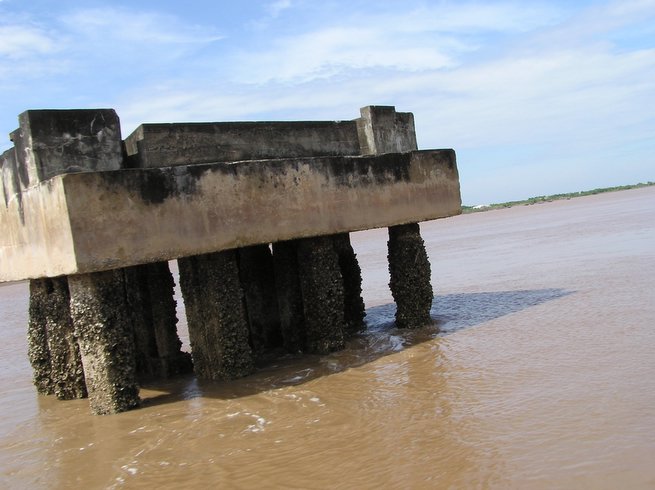
This incomplete bridge is one of the reasons my family left Viet Nam. My father's land, and my father's family's land, was taken by the government for reasons that included the building of this bridge. Twenty something years on, and this is the bridge. It sticks out no more than 10 metres from the river bank - indeed it is not even joined to the river bank, just a random structure of concrete and steel, jutting out of the Mekong, without purpose and abandoned. It makes a joke of our leaving for a new life.


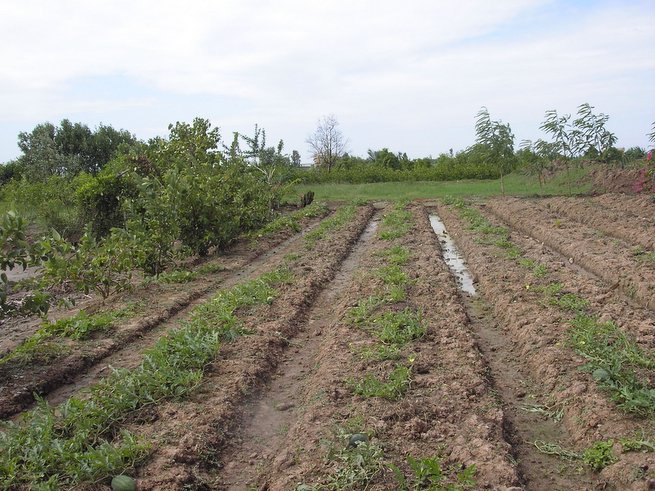
These neat rows of well-tended vegetable garden is where my family home was.


I am pleased that my father's home is now a thriving garden of watermelon, herbs and 'rau cai' (a medley term for an assortment of green vegetables necessary for all meals). Ba is an excellent gardener, and it is appropriate that the home he built should birth meals for his younger brother's family.

***

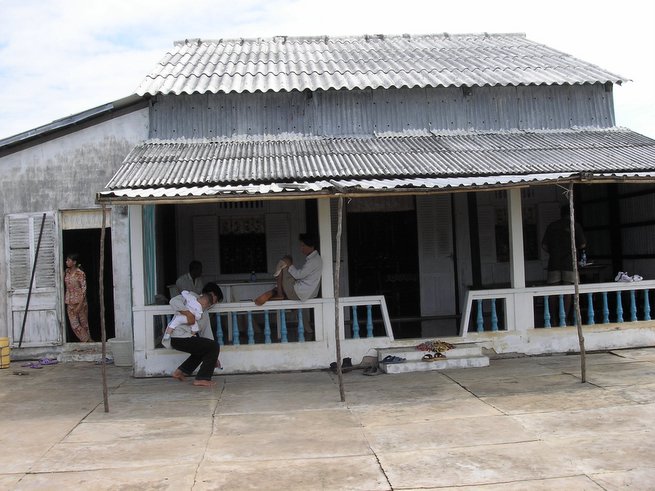
This is my uncle's home, which is directly behind the garden above. It is made of concrete and corrugated iron; inside it is tiled and cool. It is a rich man's home for the region.

On one side of my uncle's house lives another aunt - older than him, but younger than my father - one the other side is another uncle. Their houses are built of palm and patted clay.


My father is sitting in the left corner - the guest's place where he sits and is served tea, coffee and food, where brothers, sisters, cousins, nieces and nephews come by to meet him. One of my female cousins leans against the door, taking a break from her daily work, or calling a child home. A cousin's husband is carrying around his son, stooping to pick up something. A visiting uncle perches on the banister, chatting with my father; and the uncle whose house it is, is gathering the tea things - to make more tea, so the decade of catching up is lubricated well into the late afternoon.

***

This is one of my younger male cousins, resting from his work. He is perched on the fishing net that delineates where this place is. It is an unamed place, except for the number of the fishing net (9). This is Hang Day Chin - fishing bay no. 9 - where my family hail from.

Saturday, April 22, 2006

Hoi An

Hoi An is a beautiful town.


We sat in this cafe staring out as the river rose and rose even though the rain had stopped hours ago.


And then men on hondas, with women clutching their waists, whizzed past. I wondered how high the water would come. My answer was - so high that we had to exit the cafe through the back door. The poor street seller who had his wares laid out on the footpath - had to pack up and move elsewhere.

Anonynmity in Hoi An

This is one of my favourite photos of me. Mostly because I don't really look like that. And it's such a well composed picture, don't you think?


Taken at the delightful Mango Cafe in Hoi An town. There are chyrsanthemums in the foreground, the window is painted in bright blue, a palm tree and Hoi An's main river just outside.

I had a splitting headache but loved the town. My sisters wanted to do more shopping but I wanted to watch the world go by. I'm just not into haggling when a little woodpecker is jabbering away behind my right ear.

I sat outside for a bit and chatted to three male tourists at the opposite table. The Accountant took this photo while I wasn't paying any attention.

I smile a lot - happens when you grow up and your mother is telling you always to smile. The three men were nice enough and I told them a little of my history. They were a ragtag bunch of travellers - little in common except that they were on the same tour. The youngest was Greek and had been in Australia a few months prior, the two older were from the UK and America. They were intrigued by the fact that my sisters and I spoke a mish-mash of English and Vietnamese.

After I told them we had been Viet refugees and were now Australians, the American delighted in wanting to know if I was going to visit My Lai.

I was short with my response. No, I said. Why not? He said.

I stared at him.

I don't think it is appropriate, I said primly.

He stared at me. It's your history, he said.

I looked at him quizzically, my ire growing. I could not really articulate why I did not want to see, and that it had never occurred to me to visit, My Lai. I had been shocked by his asking. Although an important part of the American War, and an iconic turning point in the rest of the world's understanding of who was really being hurt in that war, I could not bring myself to contemplate visiting a place where so much horror and agony had occurred. I can't imagine making it a place to visit, on a tour of a country. Just like, though it is not part of my culture's pain, I would never vist Auschwitz.

It was difficult enough to contemplate reconciling myself to the Viet Nam of today, let alone the Viet Nam of 1976. And what about my history beyond the war that got Viet Nam to the notice of the rest of the world? Just because the Viet Nam / American war and the My Lai massacre might be part of this man's guilt and understanding of Viet Nam - it wasn't mine. I didn't quite know, and don't know still, what is my understanding of Viet Nam. (My guilt is more explicable.) But there's more to it than the War.

I don't recall my answer after that. Some muttered politeness and we left.

Sunday, April 16, 2006

Beautiful Bonsais and Gargantuan Gates

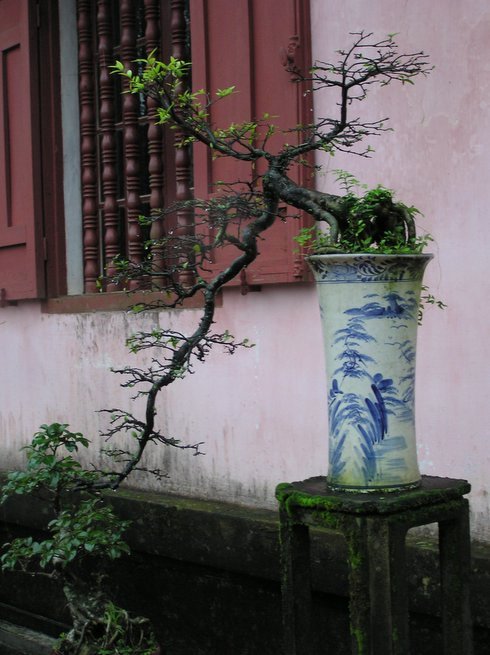
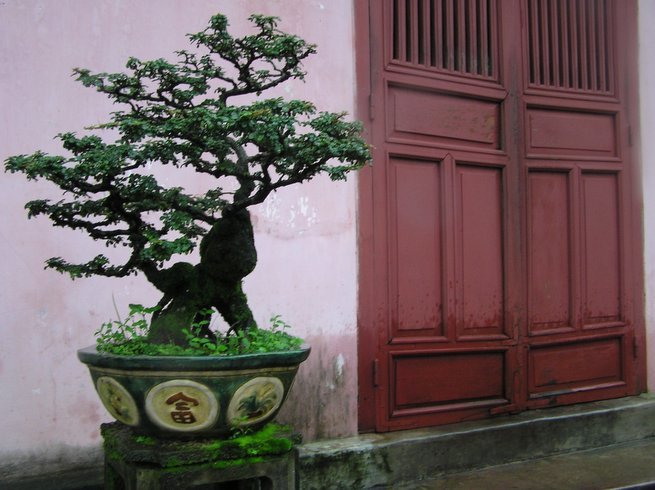
Bonsais at Thien Mu pagoda, Hue:-


One day, when I am old person with two much time on my hands, my own home and control of the weather (ie no drought), I will have bonsais. And they will be as mesmerising as these - even if it is only because I am competitive. Throughout Viet Nam's temples and pagodas were numerous delicately crafted bonsais (large and small). They are such meditative plants.

***

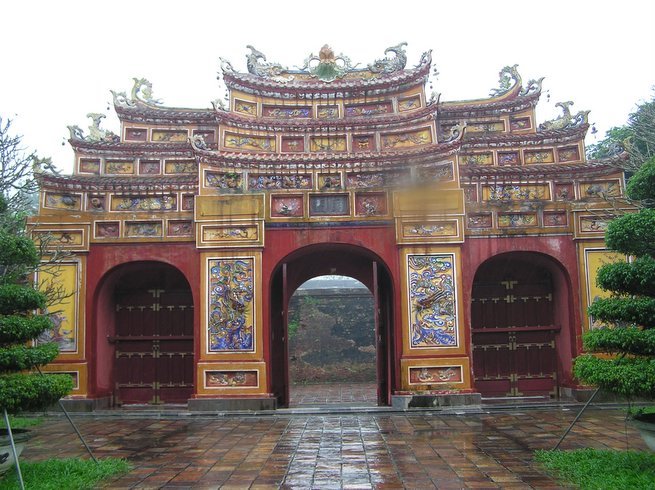
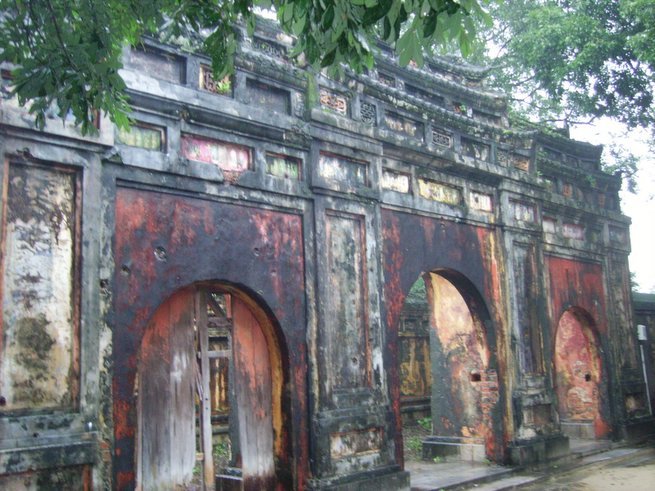
Something that is not meditative are these incredibly ornate gates in the imperial citadel. The splotch is a rain-drop - not me being a terrible photographer.


If only I were still an ancient historian - I could turn my hand to archaeology and assist the Vietnamese to restore their tourist attractions and historical monuments. Some gates were well-kept.

Others were not:-


There were also ancient paintings hailing from the 14th century that were just happily on display, close enough to be touched by all and sundry (except for the sundry short people) and photographed by everyone - except me. It was my ethical stance - my camera flash was not going to contribute to the further deterioration of the imperial paintings. It is not worship of material items - merely recognition of historical value. In the same way that we should tread softly in rainforests and areas that retain their pre-human beauty, so too should we preserve the precious endeavours of our forebears.

Of course, it all comes down to money - the tourists bring in the bucks but they also contribute to the destruction of the things they have come to see. Vicious, vicious cycle.

Sunday, April 09, 2006

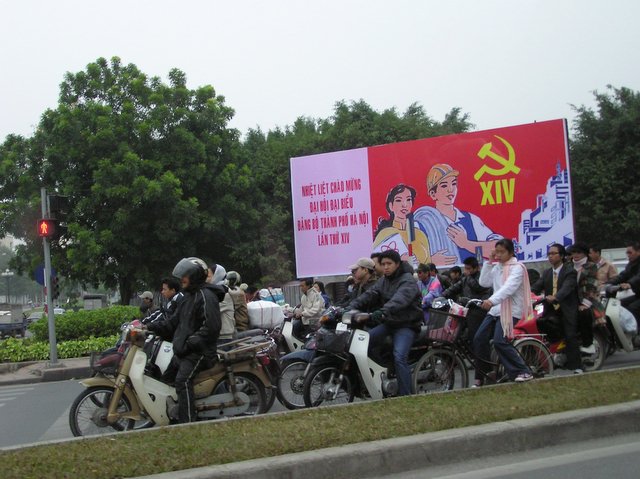
Communist Propaganda

I think that I shall let these speak for themselves. Why get myself into more trouble?


Friday, April 07, 2006

Temple of Literature

The imposing entrance gates to Viet Nam's first university:-


As you enter, this vista of peacefulness greets you:-


The accountant's reflection in the honour roll:-


I loved the Temple of Literature. I wished I was on my own and I would have sat myself down on the inviting grass, opened up whatever book I had at the time and whiled the rest of the day in the complex.

I would also have loved to have been a student of the Temple of Literature. I can picture myself, nose buried in book, mind half composing poetry and hoping to become a public servant (har har). Oh, except that I would have to have been a man. No, thank you!

Monday, March 20, 2006

Blue Dragon Children's Foundation


This post is in honour of this worthy site. Work be warned: I have an organisation to donate our next casual Friday coffers to.

I met these gorgeous kids at Thien Mu pagoda in Hue. The rain steadily drizzled and most of the tourists were huddled under the eaves of one of the pagodas. I did not go in. I left my sisters and the tour guide and wandered around the serene grounds of the pagoda where beautiful bonsais were artfully displayed. I was warmly protected from the rain in my bright red raincoat.

These children - the eldest's name was Hieu - fell about laughing whenever I opened my mouth. In English they said:"Where you from?" and in Viet, I responded: "nguoi Viet o Uc" (I am a Vietnamese person living in Australia). Oh, how they laughed. First, a nervous giggle. But then I said: "What are your names?" (in Viet) and they started to double up. The eldest responded, nudging the littlest at the same time who was hopping from foot to foot. When I asked if they lived near the temple, they almost fell into the pond laughing at me. We shared some sugar cane lollies I had in my bag, I took this photograph and they laughed as I and my red raincoat continued to meander about the pagoda grounds. I have never been so funny in my life.

Thursday, March 09, 2006

Ha Noi Traffic

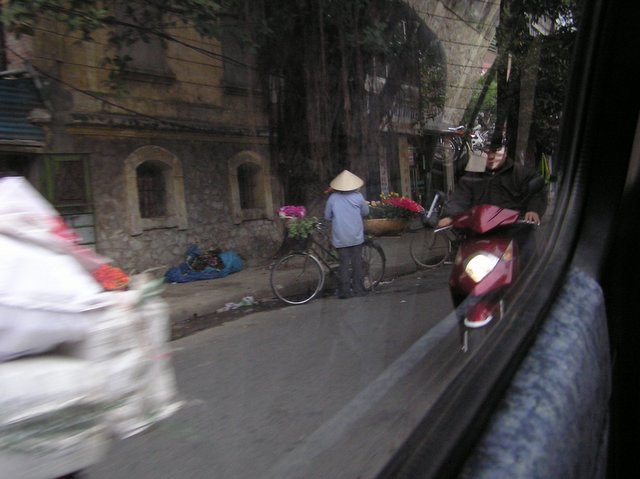
Welcome to Ha Noi! Land of communist propaganda posters and young Vietnamese on Hondas!


I loved the street sellers - especially early in the morning. Rows of women with baskets full of roses, marigolds and carnations lined up alongside Ho Hoan Kiem (lake) to sell their wares. Each one had only one colour and type of flower in her basket. If I lived in Ha Noi, I would wake every morning to buy flowers.


And some Ha Noi folk are just plain crazy.


The best part, however, is crossing the street.

It is an unusal sight to see Ha Noi traffic stopped at a stop light. Most drive blissfully through, horns honking away. Only outside the Presidential Palace and the Parliament building are the traffic lights obeyed - and that's probably because there are guards/police loitering nearby.

So crossing the street requires a hardy constitution. The old people do it best - by taking their time and stopping for no one. One takes a deep breath and places an exploratory foot onto the road, withdrawing quickly as another Honda goes past. But waiting for a break in the traffic is futile. One must step onto the road when at least there is enough room for a body and begin a steady and slow saunter across the road. Do not - I repeat do not - stop suddenly for anything other than a bus honking its horn urgently. The Hondas flow around you as you edge across the road and you must have faith in their ability to see you and dodge you. You do not dodge them.

I perversely enjoyed crossing the road in Ha Noi, horrifying my sisters when I crossed diagonally across a five way intersection because a gallery over there caught my eye. There must be a kernel of crossing crazy Viet traffic in my blood, because I have always been a somewhat absent minded road crosser and, though dangerous in Australia, am rather suited to Vietnamese city traffic. With your mind on other things (like the brilliant red oil painting you can only just glean the corner of or what you will have for dinner that night) the incessant horn-honking morphs into a pleasant, chatty background noise; everyone is saying "Hi!", "Hey There!", "Nice Coat", rather than "Get out of my way!" or "Idiot! Trying to kill yourself?"

Saturday, February 11, 2006

Ha Long Bay

The sky, a deep blue sea
A golden boat,
wind-driven, lists and tilts -
unmoored, it sinks.
And coldly, time flows on.
~ Tran Gia Thoai

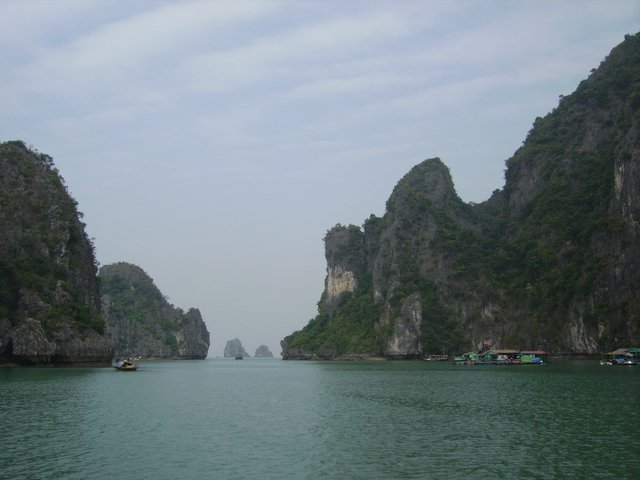
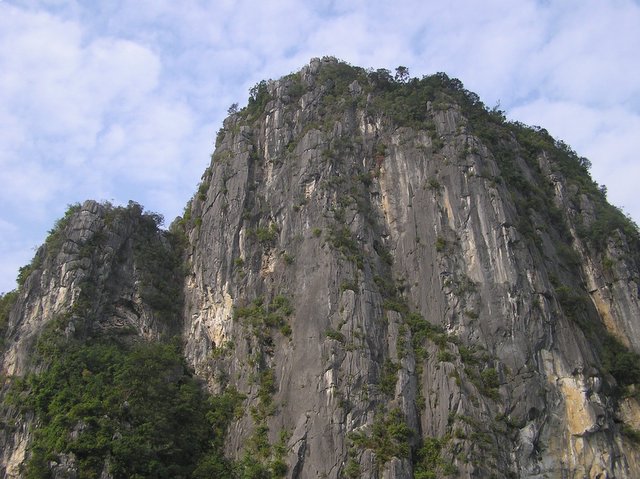
A poem actually about a falling leaf, but I hijack it here to capture the ephemeral beauty of visiting Ha Long Bay. These pictures don't really do Ha Long any justice.

We were so lucky - it was just my sisters and I (and our tour guide and the boat crew) on our Halong boat. Such a delight to have the entire boat to ourselves, and hence, the entire Bay too. Miles, acres, gallons of water and grey overcast sky were ours alone to meditate on and enjoy. It was the most thoroughly peaceful experience, siting at the end of the boat and just widely arcing the bay, watching the sea eagles dip and soar overhead, and marvelling at the limestone cliffs in all directions.


I loved the looming limestone cliffs, wild and untrammelled by tourists' feet, who must admire from afar. I took these because I hope to head back one day and explore the cliffs more intimately and directly - to climb all over them with the backdrop of the deep blue-green sea and the overwhelming serenity of the place.


I watched this woman and her child - or grandchild - row almost a kilometre at a measured pace. I could not help but covet the peacefulness of the journey, although I do not actually know for what reason they were rowing.

The child looks to me like he is being berated, head hung in shame.


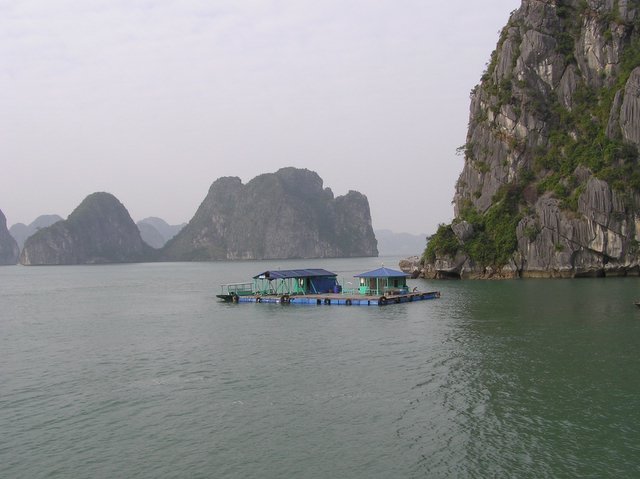
I wish to live in this house - I came home and told my partner we were moving to Ha Long.

I am sure that there will be satellite facilities and my workplace will be more than happy to accomodate me working from home, from the China Sea. And then I wake up from my dream. I am not a very strong swimmer, and nor is my partner, and living in one of these houses is clearly asking for trouble!

But still, I have long dreamed of my own home.

I used to be an insomniac and my trick to get myself to fall asleep was to picture a home; I visualise and decorate it thoroughly. I usually fall asleep by the time I get into the backyard. I still use this trick when I am having trouble sleeping. The house I imagine changes; sometimes I am so familiar with the home that I merely have to start and the rest of it fills itself in for me.

The houses have changed as I and my desires change. When I was in high school and desperately wanted more privacy than my large family could give, I visualised a large warehouse, the edges filled with book-shelves from floor to ceiling (a recurring decoration in all my homes), and my bedroom and bathroom in a loft, in one corner of the high-ceiling warehouse. I don't recall installing a kitchen. Currently, the home I picture is environmentally sound - using it's natural surrounds (it's built on the side of a cliff) for light, heating and cooling. It has solar power, and water tanks. The kitchen is large, full of shelves for my many herbs and spices, and hanging space for my cooking utensils. This is my current phase in life - attempting to live more consciously of my impact on my environment.

Ha Long is a 360 degree experience, inside and out.

 
Creative Commons License
This work is licensed under a Creative Commons Attribution-NonCommercial-ShareAlike 2.5 License.