Showing posts with label Bookish. Show all posts

Thursday, June 12, 2008

Book Meme

I found this meme while rooting around the archives of The Hidden Side of a Leaf -a blog I stumbled on because I liked the blog title. I was sort of hoping it would be a photoblog, but was nevertheless pleassantly surprised to find that it was a book-blog.

I have not written a post for a while, especially not one about books. Partially, this is because I have not been reading as much as I would like to. Partially, this is because I feel like I should review 'Growing Up Asian in Australia', but I do not think I am capable of it. No distance, you see.

So, a meme to jolt me along.

The breakfast table read:

On weekday mornings, I am invariably running late. I sometimes lackadaisacally flick through the various magazines we get delivered to our home - The Economist for news and then all the magazines that go with all our memberships: hiking magazines, human rights magazines, history magazines, wildlife magazines. I just look at the pictures. Sometimes, especially in the Economist, I stare at the advertisements, trying to understand what it is that they are appealing to. Usually, there is a picture of an actor posed somewhere luxurious - the colours and background are muted and neutral, but the actor is in sharp focus, doing something iconically that actor-ish. I cast around and around the advertisement looking for the luxury item I am being sold - sometimes it is a chain of hotels, sometimes, an airline, sometimes luggage. All the advertisements look the same, and I cannot imagine myself wanting to stay in that hotel, or use that airline, or carry that kind of luggage.

On weekend mornings, I read the backlog of magazines with slightly more attention, although of late, my news-reading has been marginal, at best. I fear I am turning into an old lady: I go for the book and movie reviews, then cooking, then gardening. My news, I now read online throughout the week, through an RSS feed, through blogs.

The to-go read:

I like to have a paperback with me wherever I go. It has to be light and thin, but it does not have to be light-weight reading. At the moment, my to-go read is Twilight of Love: Travels with Turgenev by Robert Dessaix.

My to-go reads often don't get read when I am on the go. I have excessive ambitions about what I can read when I am on the go. Thus, Twilight of Love was my to-go read sometime last year: I picked it up, threw it into my bag but somehow it ended back on the shelf. It was quite exciting to pick it up again and discover a postcard slotted in there as book mark - a postcard from Winchester, one of our first UK tourist visits.

The bathroom read:

When I (or someone more pragmatically minded and ingenious than me) finally invent(s) my magic book protector-cum-page-turner, I will read in the bathroom. Otherwise, I will not.

The read-aloud:

Occassionally, I read poetry aloud, to myself. Poetry is meant to be read aloud.

My current book of poetry is by Bryan Thao Worra. In quiet moments, I pick up my copy of The Other Side of the Eye, which has been inscribed in the front by Bryan (thank you, Bryan, for your lovely note) and read a piece, firstly to myself, and, if no one is around, aloud. I try to mimic how it would be presented, guessed from photos of Bryan: his gestures and the shape of his mouth. I wish I could see him read his own poetry, in person.

The main read:

My main reads change. I have a lot of main reads at the same time. They change and they accumulate. I will have a main read, and then get a to-go read, which becomes a must-finish read, thereby converting it into one of the main reads.

The most recent was The Golden Gate by Vikram Seth, a man who is much, much too clever. The Golden Gate is a novel in iambic tetrameter. Now, really, Mr Seth, must you? It is excellent, and funny, and sad. And even his autobiographical note is in iambic tetrameter. And chuckle-worthy.

The work read:

I read all the time at work: letters, cases, articles, pleadings, journals.

I often get aggravated by the things I read at work, for a variety of reasons: because I disagree with it; because the writer has confused effect and affect (argh!); because it is poorly written; because the author is someone who makes me sigh in frustration. So many reasons.

My recent aggravation came from a facsimile, the gist of which was, "We're just writing to let you know we represent the guy on the other side, 'kay?" What was aggravating about that? It was headed URGENT FACSIMILE TRANSMISSION. No, that communication is not. Reception telephoned me, rather than dropping the fax into my pigeon-hole for me to pick up at my leisure as would usually occur, to tell me I had an Urgent Fax. Naturally, I stopped doing what I was doing and traipsed over to Reception to collect the Urgent Fax, only to read its complete mundanity. Stupid people. Learn to prioritise and look the word 'urgent' up in the dictionary. I am tempted, but not rude enough (and I have other things to do), to fax back a letter with the heading FOR THE IMMEDIATE ATTENTION OF: and a photocopy of the relevant page in The Oxford English Dictionary. Churlish, yes. Unjustified? No.

The travel read:

I like to have a mix-up for my travel reads: I like a collection of short stories, a non-fiction and one or five novels (depending on length of travel and activity/ies to be engaged in). Sometimes, one of my novels will be a children's story or (gulp) romantic fiction by Katie Fforde. Ms Fforde is fantastic for long-haul flights and my (no-longer) secret, guilty, pleasure read.

My current collection of short stories is The World and Other Places by Jeanette Winterson. My current non-fiction is Wanderlust: The History of Walking by Rebecca Solnit (although I have to admit to such a long pause in reading it, that it almost qualifies as ceasing to read it altogether, except that, in my head, I'm still reading it) and Flights of Fancy by Peter Tate, which sort of also belongs in the short stories collection because each chapter is on one bird, and I feel I can read chapters in whichever order, at my leisure.

New category - the audiobook:

I don't get along with audiobooks.

I tried when I first started driving a car, and was reading less because I was spending less time on public transport. It did not feel right, and the voices annoyed me. Plus, I found my mind wandering.

I tried again recently when I was really, really ill for a week at the end of winter, beginning of spring. I listened to old-school mysteries because I was too sick to read. I'm not sure I'd do it again, though.

*****

Do you like this meme? Do you want to do it? Go right ahead. And let me know in my comments.

Saturday, May 17, 2008

Growing Up Asian in Australia - the Book!

Last week, I cycled to the post office to pick up a parcel: a collection of stories, of which my Conversations with My Parents, is one.

The collection is called "Growing Up Asian in Australia", edited by Alice Pung and published by Black Inc. Books.

When I opened the parcel, and saw the book, I wanted to ride home immediately to start reading it. Instead, I had to ride to work and start work. I was bursting with impatient excitement for lunchtime, but I did not know where to go for lunch. If, as would usually be the case, I had a sandwich, I could just head to the Common and read my book on a park bench. Sadly, I needed to buy something to eat, so I decided to go 'next door'. I did not want to go any further afield, because that would reduce the amount of time I had to read my book. The main problem with having lunch next door, is that other work people are next door. I did not want to talk to anyone.

Luckily, no one I was actually friendly with was next door, and all I had to do was chirp "hi!" to some people, take my own seat at my own table and stick my nose into the book. There, I was transported to a world of stories - some comic, some poignant, some familiar, some less so. I was a bit discombobulated when a work mate said, "What are you reading?" And I mumbled into myself with eyes far away, so unlike my usual work self, "Just a book", showing her the cover and hoping she won't take it from me to flick through, to find me in there, to force me to be pleased about my inclusion in the collection with her, whom I care nothing for, when I have not told most of my friends nor indeed any of my family, except one of my sisters. Thankfully, she says, "hmm, interesting", in a way that indicates she finds it very UN-interesting. I walked off without saying anything else.

I'm not exactly sure why I haven't told many people. I told my sister as an afterthought, at the end of a telephone conversation, about two months after I knew my piece was included. I told friends at random, and I'm not even entirely sure who I've told, and who I haven't.

I wrestled with whether to give my full name to the piece, or a link to this blog. I kept most of the wrestling to myself, although I did precis my thoughts for my partner. As usual, he helped me order my thoughts, and come to a conclusion.

Reading through the book gives me the same odd feeling I have mentioned before, when viewing a migrant exhibition: a depressed sort-of lassitude mixed with urgent inspiration. I can do this, people are interested in my stories. But I don't have time. I'm not good enough. My writing is mundane, imprecise, amateurish. My stories are so similiar to all these. It will bore everyone. I'm just flailing about the place, pulled in a myriad directions. I'm not that passionate about my family. I'm not that passionate about my work. I'm not that passionate about my self, or the struggles I've been through to become happy about being me.

I love my family. But they deserve their privacy.

I'm okay with my work. And not stupid enough to jeopardise it on my blog.

I'm reconciled with my self, and if I'm completely honest, quite happy about being me, and for most of my life have been so. Hell, I never struggled very hard. I had a big, accepting, loving family. I went to school in a large multi-cultural community, where if you called me chink then I called you whitey, and we were square. The cuts never cut much deeper than skin, because I have a reserve of strength, because I fought, because I was me, and I have always been okay about that.

Don't buy the book for my story. You've probably already read it, and if not, just click on that handy link up top. But do buy it for the whole collection. There are some duds - there always are in any collection - and your duds will differ from my duds, because, you know, we're different people and we have different tastes.

Wednesday, December 19, 2007

The Bluest Eye

I finished this book on the train from one client meeting to another. For many reasons, the book struck me and I hope I was as moved as Toni Morrison wanted her readers to be.

This struck me:-
We were so beautiful when we stood astride her ugliness. Her simplicity decorated us, her guilt sanctified us, her pain made us glow with health, awkwardness made us think we had a sense of humour. Her inarticulateness made us believe we were eloquent. Her poverty kept us generous. Even her waking dreams we used - to silence our own nightmares. And she let us, and thereby deserved our contempt. We honed our egos on her, padded our characters with her frailty, and yawned in the fantasy of our strength.

And fantasy it was, for we were not strong, only agggressive; we were not free, merely licensced; we were not compassionate, we were polite; not good, but well behaved. We courted death in order to call ourselves brave, and hid like thieves from life. We substituted good grammar for intellect; we switched habits to simulate maturity; we rearranged lies and called it truth, seeing in the new pattern of an old idea the Revelation and the Word.
[p163 of my edition]

There are some books, and films that make me quiet inside. And there are others that have my mind racing. Incomprehensibly, this book did both, at once. As I walked through icy winds from the train station to my workplace, I thought about these words. I thought about being not good, not free, not strong. I thought about how I delude myself into thinking I am these things.

I thought, also, about another passage that struck me in the book. That struck me because it sounded like it could be about me - or at least (or worst?) an eloquent articulation how I am feeling about myself at the moment.

[H]e found misanthropy an excellent means of developing character: when he subdued his revulsion and occasionally touched, helped, counseled, or befriended somebody, he was able to think of his behaviour as generous and his intentions as noble. When he was enraged by some human effort or flaw, he was able to regard himself as discriminating, fastidious, and full of nice scruples.

As in the case of many misanthropes, his disdain for people led him into a profession designed to serve them.
[from page 131 of my addition]

I could keep on in this vein. I could keep typing out passages in some kind of homage to Toni Morrison's ability to hold a mirror to my view of myself, and of the world. I would be doing so mostly to impress upon you the need to experience Toni Morrison's ability to hold a mirror up to yourself. You will probably find different things that hit you where it hurts, that make you confront some ugly truth you don't want to admit about yourself. But you will find them.

The first novel I read of Toni Morrison's was Song of Solomon. Someone gave it to me thinking it was a rendering of the Biblical love story of Solomon. And certainly, it was something like that. (Not that I am overly familiar with Biblical stories, but I suspect Toni Morrison is.) I know, when I read Toni Morrison, that I will be horrified and saddened, and rendered so much more human because of my horror. But I have never before been so discomfited - and not because of the incestuous rape of a character by her father - but by the way she has implicated me - the reader of a piece of fiction - in the act.

I could more succintly say what all the above ramble means: You, too, should read The Bluest Eye.


Powered by ScribeFire.

Sunday, October 28, 2007

Another Book Meme!

Tagged by Lotus Life, who seems capable of magnificent motherhood, full-time work, study and blogging, while I struggle with work and blogging. I suck. But I forgive myself.

1.Hardcover or paperback, and why?

Paperback, all the way. Hardcovers are too heavy: you can't throw them into a bag to take with you, or slip them into a coat pocket, or justify lugging them up a mountain.

In my early university years, and when I was an Arts student, I used to wear a big beige coat that had two enormous pockets. In one pocket, a notebook, my house keys and wallet. In the other pocket, a beat-up paperback and a lollipop. I loved the freedom of those days, wandering the university campus at my leisure, unburdened by a bag and heavy books. I was into Beat literature at the time, so it felt very bohemian to be so unencumbered. The lollipop was to keep me going because I was too poor to buy food: the sugar sufficed until I got home.

I became known in my Classical Mythology class as "The Lollipop Girl". I did not know anyone in the class, so I used to sit alone, up front. The first few tutorial sessions that I went to did not suit me, so I changed. And the first time I introduced myself to my new tutorial class, one of the other classmates piped up with: Oh! You're Lollipop Girl. It's good to know your name at last.

2.If I were to own a book shop I would call it…

Ugh. I'm crap with titles / names. I would probably ask everyone I knew for suggestions, or some random conversation would titillate me and that would become the book shop name. And it would be rather convoluted, and probably not very catchy. Kinda like the title of this blog.

My bookshop would also be a tea room & cafe, pho kitchen, laundrette and cinema. Everyone who wanted to could hang out there for as long as they liked, with nary a purchase required. The tea room would have bird cages, but without birds, because I can't abide the thought of birds in cages. Maybe the bird cages would double as lamps. Long benches and chaise lounges and comfy arm chairs and cushions and lots of little tables would be dotted all over the place, and bookshelves of all sorts and sizes randomly abound. Turning a corner would confront one with a new vista of books and great chairs on which to sit.

And it must be a second-hand book shop. I will know every book that has come into the shop, but I will resist the temptation to alphabetise or categorise them, wishing instead serendipitous book discovery on my customers. I sort of want my book shop to have a cat, but I don't like that cats kill wildlife. So I'm torn on the cat front.

There will be tea of every imaginable description, and teapots, collected from charity stores, of all kinds. Oh! And the coffee paraphernalia. Lots of that too.

My cinema will be cosy and have sofas and side tables. I will show an eclectic selection of film: from anime to horror, art-house to thrillers, with a smattering of period drama thrown in.

And there will be a laundrette because every one needs clean clothes.

3.My favorite quote from a book (mention the title) is…

I really like a particular quote from To Kill A Mockingbird by Harper Lee. The quote is about both Atticus and his relationship with his children. It is written initially in high-faluting language and then ends in a great twist of simple childish slang, jerking us straight back to Scout's perspective.

Jem and I were accustomed to our father’s last-will-and-testament diction, and we were at all times free to interrupt Atticus for a translation when it was beyond our understanding.
"Huh, sir?"

Like a lot of lawyers, I suppose, I love To Kill A Mockingbird. I identified quite keenly with Scout, and Jem was definitely my older brother, who is wiser and kinder than me, and whom I worship. Scout is a reading, blustering, naive and occasionally thoughtless, but mostly decent-hearted, tomboy. There's a lot of me in her.

4.The author (alive or deceased) I would love to have lunch with would be…

Roberto Calasso. He is very much alive, and must have a lively, inquiring mind. He is the archetypal polymath, I think, and I would melt in his presence.

5.If I was going to a deserted island and could only bring one book, except for the SAS survival guide, it would be…

Eh. I probably would not bring the SAS survival guide. I'd bring my Ba.

Book-wise: I really find this prompt an incredibly difficult one. I just can't get past the idea that if I'm on a deserted island, I probably did not plan to be there so I wouldn't know what book I will have with me. And it will have to suffice, won't it? It's somewhat contrary, because I don't have any difficulty hypothesising about an author whom I would like to lunch with, or detailing my imaginary bookshop/tearoom/cinema.

I know that the idea behind the prompt is what one book could I read over and over again, and which would keep me from going insane all on my putative lonesome; I just can't think of one that would fit that bill.

6.I would love someone to invent a bookish gadget that…

held my books and kept them dry in the shower! yeah!

7.The smell of an old book reminds me of…

other old books: The Life Line Book Fest! I have posted on this over here.

8.If I could be the lead character in a book (mention the title), it would be…

I usually want to be a character in every book I am reading, although not always the lead, and usually someone who is already remarkably like me but better in some way.

9.The most overestimated book of all time is…

The last Harry Potter. Enough said.

10. I hate it when a book…

has lost pages in the middle and you did not know about it when you bought it.

I once purchased a second-hand novel by Richard Brautigan, without realising that it was 'seconds' rather than second hand. My partner started reading it first and churned his way through the first 100 or so pages only to find pages 101 - 157 (or thereabouts) missing. I have never seen him so upset with a book in my life. He threw it across the room, then retrieved it, only to tear at it and, dramatically, bin it. I'm glad it was not me who started reading the book. I'm not sure I would have been so restrained.

I'm craparama at tagging. But I think Katie over at Minor Revisions should give this one a go, to distract her a little from her woes, and also Galaxy, if she can incorporate it into her current segues, and N.T if she can be bothered - (in my comments, as her blog is not a talkie-one).

Wednesday, July 25, 2007

Cat's Eye by Margaret Atwood

I don't know why, or how, I came to Margaret Atwood so late in my life. She seems to be the perfect author for me and, as prolific as she is, I seem to have read much more of her non-fiction, than her fiction. I read Cat's Eye on holiday.

One of the things that struck me most about this novel was its insightful portrayal of relationships among girls and women. The protagonist, Elaine Risley, is a successful painter who returns to the town of her childhood, teenage and early adult years to attend a retrospective of her work. Alone in Toronto, she begins to reminisce about her life, and in particular her friendship with Cordelia: her nemesis, or a foil, or the example of what the protagonist herself could have become.

This post is not a review. Atwood's work is excellent, and I highly recommend her if you haven't read her already. Like much else on this blog, this post is about ME.

Cat's Eye got me thinking about my relationships with girls and women. I was a resilient child; I grew into a resilient adult. I had a large family and network of siblings and cousins of both sexes. At home, I was closest to my brother in age and, as a child, in games. I don't remember my very early childhood years but my mother's anecdotes tells of a brash, outspoken, cheeky and rather confident brat. I haven't changed much. I am hoping any child I may have will not be like the young me (I'd like her to be much better behaved!).

The first primary school that I went to had kids from a mish-mash of many and varied cultural and ethnic groups. I formed friendships with almost everyone: Indigenous kids, Islander kids, fellow Viet kids, Chinese kids, Lebanese kids, Greek kids. They were all girls.

Even in early primary school, I knew we weren't 'cool'. We were generally excluded from games of 'tiggy' (a chasing game) and I, in particular, was banned from 'catch and kiss' (I had punched the last person who caught me, before he could kiss me, because he grabbed me around the waist. I did not play by the rules.) We spent our lunch hours in one corner of the playground. There must have been a reason for that, beyond mere choice. After all, the monkey bars and the swings were in the diametrically opposite corner of the playground. I remember playing on the monkey bars and swings AFTER kids had left school for the day. So there must have been someone preventing me from doing so. I have no recollection of who they were, nor why. Although I'd be quite happy to take a racialist stab in the dark.

In grade five (aged eight), we moved from inner city, mixed class, multi-cultural, to outer suburbs, blue collar, mono-cultural. I and my brother were the only two Asian kids the school had ever seen. The school I attended was a very small school, which was a shock to me. Previously, there would have been more people in one of my classes, than in the entire school. It was not large enough to form cliques, so most of the time, everyone played with everyone else. But there was the occasional spat. I got into fights a lot. I have previously posted about one particular not-quite fight.

Grade 5/6 was when the social outcasting bullying set in: I would have been 10/11. My brother was in grade 7, the last primary school year, at the time. At that age, everyone was at markedly different stages of physical development. I was still small and weedy and childlike. So was my brother. Some of the girls who were my friends had begun to develop breasts and hips, and a giggling interest in boys (still germ-filled in my eyes). Some of the boys had a swagger and were heads and shoulders taller than everyone else.

One rainy lunchtime, I came out of class to sit with the usual circle. As I fought for a space between two people, they turned their backs to me, shuffled forwards and closed me out again. I got up and went to sit beside someone else, also in the circle. The same thing happened. I persisted and sat there eating my lunch in a strangled silence. A few of the group got up and moved. Then, one of the girls came over to me. She had, a few weeks earlier, declared that she was my best friend. She whispered that everyone was unimpressed with me because one of the boys, whom another of the girls liked, might have a crush on me. That boy was my brother's best friend, and he was, of course, full of cooties. While she was talking to me, her head swiveled back and forth; she was watching how the other girls were reacting to her talking to me. "I hope you don't mind," she whispered, "but we've all agreed not to hang out with you", and then she scuttled back to the group, who were by now all facing towards me, hands menacingly on out-stuck-hips.

I remember being bewildered, and not saying anything, but feeling that it was absolutely necessary that I did not move; that they move. So I just stood there, looking back at them. I may have looked sad or fearful or confrontational. I don't really know. It did feel like I had done something wrong, but I was definitely not going to say sorry. And they had not exactly done anything to allow me to lash into them, as Craig had. They whispered together, giggled together, and then left. After they had gone, I deflated, and slunk off into the library.

The next day, I did not bother. I went to join the kids in the junior school and sat with kids 2 to 3 grades below me. I played on their swings and monkey bars and fortresses. I played chasey and skipping rope games again, instead of sitting around gossiping at lunch.

Though my friendship with the older girls re-ignited, it never felt true afterwards. I was wary. And if they shut me out, I defended by disappearing off to have more fun with the younger kids. Some days I just played their games, which were much more fun anyway.

In high school, three girls one grade older than me decided I would be fun to pick on one term. Wrong choice. They gave me a nickname (midget), because I was short, and I hung out with girls, one in particular, who were at least a head taller than I was. One of my friends became quite friendly with them, which was fine by me. The three would be sweet as pie to me when my friend was around and horrid to me when she wasn't. My friend did not understand why I didn't want to spend time with them, like she did.

I had quite quickly developed a reputation at high school for being arrogant - I presume because I was reasonably confident in my abilities, and tended towards cold silence when angered. I do recall being hurt by them, but I always did my utmost not to show it. When they taunted, I stared at them and waited until they left. If I was walking by, and they would begin to taunt, I would stop and look at them, stubbornly standing still until they went quiet. Then I would move again.

I broke my silence, once.

I was walking along the crossover area between the grade nines and grade eights, going to class, I think. I was by myself, as frequently occurred. Ahead, I saw the three girls, surrounded by a bunch of guys, one of whom was my friend's boyfriend. One of the girls called out: "There goes lonely little midget. When is she going to get a friend?" I stopped. I turned towards the girls. My friend's boyfriend said: "Oh, leave her alone. She's alright." I spat at him: "I don't need YOU to defend me. I'm FINE on my own." I started to walk off when one of the girls began laughing: "I know what gets midget. Someone CARING about her. Not so tough now, are you midget?" I straightened my probably already ramrod straight back and kept walking.

The girls moved on from taunting me; they probably found another target.

University was different: there were no obvious cliques at university, and the cool girls who would have done all this alienating stuff just did not seem to be around. But they were back again at the very first job I started. Silence and staring does not work so well when you have to co-operate together on projects. I just pretended I was part of the group during working hours, and ate my lunch with other people or by myself, and let the sniggers behind my back be just that: sniggers behind my back. My clothes were not as nice, and I did not like the same movies. If they couldn't be my friends, they were nevertheless work colleagues. They might not like me, but they were definitely going to respect me.

The cliquey work girls did respect me: they sought my advice and assistance when things went wrong. And I would give them my advice and assistance, and raise an eyebrow and sigh when they excluded me from invitations to lunch or nights out.

In a moment of blogosphere coincidence, Minor Revisions has a wonderful piece on this intangible form of bullying, called "Why don't you like me?" I like Post-Doc's mum's advice: (paraphrasing): There are too many people in this world and they can't all like you. And there will be worthwhile ones who do like you.

That's good advice.

I can hear my defensiveness as I proof-read this post. I am defensive. It does hurt to be excluded. But if people don't like you, that's their problem: just as long as they respect your work. Now, I figuratively stand still and stare people down: I stare them down with my work.

Monday, November 27, 2006

Review: Parable of the Sower

by Octavia Butler

Don't you hate reviews that tell you nothing about what the reader thought of the novel, and just gives you a precis of the novel itself? Well, I'm not going to do that. If you want a precis, here it is.

If you want to know what happens at the end, you can google "Parable of the Talents", which is the sequel to "Parable of the Sower". I've not read that yet. But vague information you glean on Talents, well tell you the conclusion of Sower.

***

It's been a long time since I've read much new (to me) science fiction. I think at some stage there was a glut of science fiction in my life and the only way to move on from that was to cease reading it altogether. Like fantasy, there is too much rubbish out there. I get disheartened when I pick up a novel, read a few paragraphs to discover appalling writing style or bland story or fetishism of gadgets (sci-fi) / medievalism (fantasy) / magical worlds (also fantasy). Nothing is wrong with each of those things of themselves, they just don't speak to me. And yes, I am using a broad brush to tar sci fi & fantasy with accusations of appalling writing and bland story-telling. Other genres are equally culpable.

Nowadays, I read science fiction only on well-trusted recommendations. Recommendations from people who know my reading proclivities. So when my partner borrowed a novel by Octavia Butler and, after reading it, duly declared that I would enjoy it, I happily picked it up. I found myself a couple of days later reading the last chapter while I was walking home, dodging fellow walkers, cyclists, park benches and the occassional overgrown plant.

This is excellent science fiction writing. Octavia Butler has a dystopic vision of a world, that could easily be our world in 20 years. It is unexplained why the world has descended into anarchy; the sense of an ordered society is within living memory and there are remnants of governed civilisation: presidents and grocery stores. Good science fiction, to me, reveals flaws in our current society. This is a novel about civilisation. Many things that are wrong in our current society are depicted: racism, self-interset and greed, environmental damage, sexism. This dystopia is complex and comprehensive: it is not one thing that has gone wrong, but many. Octavia Butler depicts a violent and raw society; one in which the protagonist, Lauren Olamina, is attempting to build a new world. I really enjoyed the focus on the minutiae of self-sufficient survival: water, food, clothing, agricultural skills.

Lauren creates a religion - Lauren would say that she is articulating the truth as she discovers it - and views the world around her with an incisive and pragmatic eye. The stragglers who form Lauren's travelling companions are a mixture of the different races that comprise American society: African-American (Lauren herself), white, Latino, Asian. The explorations of how each of these individuals have survived are fascinating, if somewhat simplistically presented. Their individual stories are related in one hit, rather than revealed. Only one character is given the joy of unravelling his past throughout the novel.

Lauren is also a character created from an idea of Octavia Butler's about how society could be improved. In an essay on NPR about the UN Racism Conference, Octavia Butler raises the notion of empathy and whether this would enable society to be more tolerant, whether fewer wars would start if everyone experienced the pain that they inflicted upon another person.


"The point was to create, in fiction at least, a tolerant, peaceful civilization -- a world in which people were inclined either to accept one another's differences or at least to behave as though they accepted them since any act of resentment they commit would be punished immediately, personally, inevitably."

It is a concept more immediate than karma. Instead of the civilization, Octavia Butler creates just one character: Lauren, who is a 'sharer' - she feels other people's pains and pleasures.

It's an interesting idea, but one that Octavia Butler was ultimately pessimistic about.
She says:
"[I]n real life, what would make us more tolerant, more peaceful, less likely to need a UN Conference on Racism?

Nothing.

Nothing at all."


Octavia Butler cites contact sports and schoolyard bullying as examples for why sharing pain isn't the solution. We're a hierarchical civilisation and "[t]here is, unfortunately, satisfaction to be enjoyed in feeling superior to other people."

I think that it is not only our baser instincts that mean we are willing to inflict pain, and Octavia Butler explores this aspect in her novel. Even if we felt the pain that we inflicted on another person, there would nevertheless be situations in which we would continue to inflict that pain. Pain is part of living. And there are things that are, in the end, more important to us than not experiencing pain. In the novel, for example, Lauren herself is willing, and quite able, to inflict significant pain on other people, sometimes to avoid further pain to herself, sometimes to prevent pain happening to other people.

The theme of shared pain makes for a very interesting exploration of the dystopia that Octavia Butler creates: in a society in which pain, suffering and human's baser instincts prevail, what, exactly, assists us to transcend it? I am taken with this idea, and I would like to see how Octavia Butler explores it in the sequel.

Here's something else Octavia Butler says that resonates with me:-
"Tolerance, like any aspect of peace, is forever a work in progress, never completed, and, if we're as intelligent as we like to think we are, never abandoned."

Thursday, November 23, 2006

Detritus

Last weekend we dismantled our last standing bookshelf. The books came off and got placed into two piles: to be stored and to be given away. My partner took the shelves off; I collected the little shelf pins; and then he took out a screw driver and unscrewed the brace. Now we had multiple pieces of wood, quite a few bullet shapes and one long x-shaped piece of metal. The pieces of bookshelf were carefully placed into our little car, and driven over to my partner's parents' place for their use. Earlier during the week, we had dismantled the second last standing bookshelf and driven it to my sister's workplace, where it was reassembled for her to put multi-coloured folders on. A few weeks ago, we had dismantled the first lot of shelves.

Over the past few months, our walls have been getting more and more naked. Our living room is now devoid of books on walls and I feel bereft. I am used to being surrounded by all these books – some I've read, some I've been meaning to read, some I would never read (my partner's DH Lawrence's and Thomas Hardy's being prime examples) and some that I have forgotten that I even acquired. I always enjoy that surprise, as you are browsing your own shelves, of making a discovery.

There is a room in my house, however, that has been getting more and more full. In one corner is a stack of archive boxes: 7 stand comfortably atop each other before my partner looks askance at me as I raise a box of books above my head. Seven is the limit for stacking archive boxes when one is 5 foot nothing. Along the floor are all the books that we will not be keeping. As visitors come to our house, we take them into this room and gesture magnanimously at the books on the floor: Take what you will, we say. Please, we beg.

I have taken to making care packages of books, to be given to people as I have fare-thee-well breakfasts, lunches and dinners with them. I put great thought into what books I choose to give to people. I start with what I know of their reading, and then I attempt to match, and expand. I have given a friend, who is spiritual, creative and feminist, Song of Solomon by Toni Morrison, Saints and Angels by Ivan Klima and Journey to Ithaca by Kiran Desai. A friend who reads indiscriminately trash and high literature provided “it has a good story” has had foisted upon her Possession by AS Byatt, Accidental Tourist by Anne Tyler and a number of novels by Carson McCullers. My niece received my complete works of Shakespeare and Norton's Anthology of Drama. I was so proud when she squealed in delight: I gave her an unexpected hug and kiss, and both of our faces suddenly got smeared with whatever goop she was putting into her hair. A friend who reads fantasy got my partner's science fiction thrust at her, with me yabbering away about the number of Michael Moorcocks that she can have (except that I have to check with my partner first).

My workmates, however, have not been so fruitful. In the lunchtime lift, I was nattering away about all the things that needed to be done before we go, when my work colleague said: Oh! And all your books! Oh, I know, I exclaimed, that's the real big task. Another newish work colleague looked bemused so the first colleague explained that I had a lot of books. Oh really? Newish Work Colleage sounded interested. So I plunged in with: Yeah, heaps! Do you like to read? If you would like any of my books, I'm more than happy to give them to you. Great she said. I was so excited – more people to give books away to. What do you read? Name a few authors and I'll see what I've got that's compatible. She grins happily and says: Thrillers. John Grisham and Jeffrey Archer. Oh, I have to deliver my disappointment and choke back a desire to say that I don't read ariport fiction, unless I am at the airport and desperate. I say lamely, Well, we read very broadly so I'll see what we've got. We've got nothing suitable, is what, and I already know it. So does she. We will not be talking books again.

The most difficult task so far has been refining my filing. A few years ago I worked up the gumption to throw out my law school notes. They went into the rubbish bin quite gleefully, with me surprised that I had kept them through two house moves. Last weekend, I finally tackled the folders that comprised my honours thesis, Latin and ancient history courses. I remember that when I finished my honours thesis, I arranged my notes and photocopied journal articles and book chapters into well organised and clearly labelled folders. I had this intention of trimming my thesis and submitting it somewhere for publication. I never got around to doing that, and I barely looked at my honours thesis after I handed it in.

I picked up the folders labelled such riveting things as: “Feminist Historiography”, “Women – General”, “Messalina – Specific” and opened them. Inside there were handwritten notes, tabbed in a variety of colours, highlighted in other colours still. There had been much cross-referencing going on way back in the ol' honours thesis days. I opened another folder labelled “Latin” and found typed out the texts that we worked on through two semesters of Latin. Beside the typed out text, I had laboriously typed out my translations. And I recalled that, not only did I do all this typing up, it was superfluous. I had done the translations painstakingly by hand, and only after it was corrected in class did I type it out. And I had kept reams of vocabulary exercises and grammar notes. No wonder I am so uptight about grammar. I kept the text and translations, but I ditched everything else.

I went downstairs and outside, pulling the bins under our study window. My partner threw the folders out. As the folders of paper sailed into the recycling bin, my pout got deeper and my frown more pronounced. When the ceremony was over, I trudged back up the stairs, now shivering from standing in the cold in only thin trousers and singlet, and curled myself into a morose ball of regret on one corner of our couch. My partner sat down and put a hand on my knee: you didn't have to throw all of that out. Years of my intellectual life, I said self pityingly. All that stuff I once knew. Gone. If only I was really sad enough, one lonesome tear would have rolled down my cheek. My partner curled comfortingly into me and drew the corners of his mouth down to express his sympathy, and affectionate mockery of my theatricality. Don't worry, I said. By tomorrow I'll have completely forgotten about it all.

I have not quite forgotten, because this blog post has been churning away inside me. But now it's written, my regret will fade away. All that intellectual stuff, gone indeed.

We are leaving Brisbane in less than two months time. Our house is getting emptier as we rid ourselves of the accumulated detritus of our past lives. I am looking forward to living with as few possessions as possible. My only weakness, I suspect, will be books.

Wednesday, October 25, 2006

A little Library Thing

I now have a Library Thing.

There are a couple of reasons why I've done this.

Mostly, I just kinda like it and I'm a bit of a geek. And by golly but I do love lists.

A lot of my new visitors (who usually are one-offs!) seem to have found me via some of the books I've reviewed. Of course, I'm probably not going to review books I've read in the distant past and I feel that it is a pity that people will miss out on a recommendation towards some of those books if I don't have a little list somewhere (I'm thinking Simone Lazaroo and Duong Thu Huong in particular). And it saddened me to see that I was one of only two people who'd reviewed The Full Story, and one of only five who reviewed The Gangster We are All Looking For (yes, I googled my own posts - but just to see what else would turn up, honest. I'm not an egomaniac. Oh, wait, I am a bit of an egomaniac). A real pity, particularly for Gangster, as it is such an insightful and lyrical work.

I considered writing a post of all the influential books I've read - but I don't like lists without explanation, and it would have been too long and taken up too much time and too difficult!

I've also read a number of book memes which started me thinking.

The most recent one was a list of Women Writers. The task was to bold what one had read, italicise what one wanted to read, place some kind of symbol beside each of (1)an author one had read but not the book listed, (2) author one had heard of but not read yet, or (3) an author one had not heard of at all. Of the lists I've seen, I've generally read or at least heard of most of the authors. But what I was saddened to see was that so many excellent women authors had been left off the list. Generally speaking, lists will leave people off and one can always quibble with the criteria for inclusion. Nature of the beast and all that. But sometimes such wonderful authors were left off (eg. Maxine Hong Kingston, whom I would expect to be part of any woman author canon) while others less meritorious were left on (eg. Amy Tan, whom I've certainly enjoyed but is not of the literary calibre of Ms Hong Kingston, in my (probably not very) humble opinion).

Another book meme which got me thinking was a list of "World Writers". There was a glut of authors from / having a connection with India but only a very few from Africa (yes, the whole continent) and Australia, and none from Viet Nam. Sure, these lists show the biases and limitations of the makers (as I have my own, and my own blindspots) but I wanted a way to get out the names of great writers of literature, preferably Asian (with a distinct bias towards Viet), preferably women and with a leaning towards Australia.

Thus, My Library Thing was created.

If you think this is all I read, you are wrong. But of what I read, these are the works I think need more attention. Some are there not because they do need more attention (eg Banana Yoshimoto) but just because she's really great. And if you're wondering, I love Haruki Murakami and have all of his books except for my two favourites (go figure!?), but he's remaining OFF my Library Thing. He really has enough attention (he takes up 9 out of the top 10 places in the "Asian Fiction / Asian Writers" group) and I'd like to see more diversity. On which criteria I might need to take Ms Yoshimoto OFF my Library Thing, because she's number one on the top 10 list! (But if she had not been on my list, the Asian Fiction group would not have found me so quickly - no more than a few hours!)

Library Thing strikes me as a very useful recommendation service. It is most often through other people - whether in my non-ether or ether life - that I discover authors I have never heard of: eg. Pham Thi Hoai (thank you NT) and Kien Nguyen (thank you Sume). And now, I can also be recommended books by all the other Library Thingistas out there.

Not that my Books in the Waiting Room need to be expanded upon ... now we just need an internet program to create more time.

Wednesday, October 11, 2006

The Full Story

by Brian Caswell and David Chiem

I read this story while on holiday. Its 100-odd pages took me barely half an afternoon and I was in tears at the end. My partner had fallen asleep, but I read on, through a blur of my own tears even as I felt myself manipulated by the over-wrought plot.

The story opens from an odd perspective: a woman, watching her son and his lover. It ends in the same fashion. The woman, we come quickly to realise, is a ghost who watches over her son. From this point, the story branches into the perspectives of her son – a young Viet-Australian man who has recently given up his law studies to pursue writing – and his lover, a young long time Australian woman who is studying art. The story tracks their romance, but predominantly it focuses on two themes: their interracial relationship and the relationship between Viet-Australian father and son. There is also an interesting, and somewhat unbelievable, sub-story concerning the past of the young woman.

There are some wonderful elements of truth (as I see it) in this novel: the pressures and guilt of a migrant life, the sadness of a lost homeland, the soaring joy and depth of young love, the sense of the Australian bush (Blue Mountains, New South Wales, in particular) and an internal battle between self-will and desire to please one parents. I was really moved by the evident guilt of the young Viet-Australian man. The predominant emotion to characterise how I feel towards my parents, is guilt: I feel that I am a constant disappointment to them even as I strive to lead my own life, within the parameters of their approval. I am less conflicted, angry and blindly rebellious as I was when I was a teenager, and they are more accepting of my choices as a grown person.

The Full Story of the story is a neat parable about a peasant and a king, unveiling individual layers of reasoning and complications in a full life to get to more and deeper elements. In some ways this parable (a very Vietnamese one, even if I say that with the caveat that 'Vietnamese' cannot be defined) reminded me of the Roman fable about the Twelve Tables. (Forgive me if I get this wrong – it comes from memory of long ago Ancient History classes). This story goes that a wise elder has twelve stone tables on which immutable laws have been engraved. The wise elder tries to sell the twelve tables to some patriarchs for one piece of gold. The patriarchs scoff at the wise elder and refuse to buy. The wise elder smashes three of the stone tables and then offers the remaining nine stone tables to the patriarchs, but this time for three pieces of gold. The patriarchs are incredulous: there are fewer immutable laws now, but they cost more?! Indeed, says the wise elder, their value has increased because they are all that remain of the original twelve. Of course, the patriarchs scoff again, and so it goes: the wise elder smashes a further three and increase the price by three times. Eventually, the wise elder has only three immutable laws left, and the price he now offers is one hundred pieces of gold. The patriarchs do not scoff. They buy.

So how is that Roman fable connected to the “very Vietnamese” (my words and my impression) full story of The Full Story? That story is about a peasant who has a very special horse and who refuses to sell it to the King. No matter how much the King offers, the peasant refuses. And unpleasant things occur for the peasant when he refuses the King, until the very last offer to buy the horse, which the good peasant refuses. He is rewarded for his uprightness in comparison to the other villagers, who have given their precious possessions to the King for various immediate rewards.

I have been deliberately vague in the retelling of the story – because naturally the parable is integral to The Full Story. It is probably a universal lesson, rather than a uniquely Vietnamese one, that the truly valuable things in our lives are not material or monetarily valuable, but I recall this being a strong element of my growing up: the lesson that family, honour and friendship was more important than material success and acquisition.

Saturday, August 26, 2006

Booked

tagged by Cee over at Words and Things

1. One book that changed your life:

In primary school, we had these readers that were colour coded: Green Reader 1,2, 3; Blue Reader 1, 2, 3; Red Reader 1, 2, 3 and so on. They were themed - myth, monsters, family stories - and got progressively more difficult. I can't recall what was the beginner reader colour and what the hierarchy of advancement was. But I do recall that when I learned to read (in first grade) I devoured these. Because I did not have many friends early on in school, I spent a lot of my lunch break in the library, reading my way through the coloured readers. The Librarian, Mrs Reeves (and I haven't forgotten her either), spotted me and my voracious reading, and put me on a course of reading well beyond my years but she thought, within my capabilities. These books were my first friends, and they changed my life because they hooked me early on.

My love affair with books has never ceased. Indeed, I will probably die surrounded by well loved but dusty tomes.

2. One book you have read more than once:

The Road from Coorain and True North by Jill Ker Conway. Okay, I cheated - that's two books. But, I read and re-read them together and therefore really consider them as one. These two books are about Jill Ker Conway's growing up in outback Australia and her difficult journey towards scholarship in 1950s Australia, culminating in her taking a presidency at a liberal arts women's college in USA. These two books inspired me in my academic pursuits and dreams (some now discarded). There is also the third instalment in this autobiographical trilogy: A Woman's Education, written much later than the prior two. I've read that too and really enjoyed it, but it did not speak to me in the same way that The Road from Coorain and True North did.

Jill Ker Conway grounds her story in the landscape and her environment - you can feel the dry heat rising when you read about her early life on a sheep ranch in western New South Wales, the oppressive atmosphere of her boarding college, the stifling and conservative academic environment in the cloisters at Sydney University and, at last, the academic freedom within the cooler climes of the northern hemisphere.

3. One book you would want on a desert island:

Probably a fat collection of essays by a brilliant essayist – Martha Nussbaum, Umberto Eco or Stephen Jay Gould. But who knows what I will have on me when stranded on a desert island - I'm bound to have some reading material and it is probably something like this: two to four novels, one or two collection of short stories, one non-fiction, one collection of essays. Hopefully I'll be stranded with my partner so that he'll have an interesting selection as well! When the two of us travel, we usually take a mini library with us - and we usually come home with another mini-library and nary a souvenir.

4. One book that made you laugh:

Anything by Richard Brautigan has made me laugh and laugh. Recently, it was In Watermelon Sugar. Which also made me cry. But my favourite, and probably because it was my first, is Sombrero Fallout. Now I'm chuckling just thinking about them.

5. One book that made you cry:

Recently, the Full Story by Brian Caswell and David Chiem.

It is the story of a young Viet-Australian man, who leaves his study of the law to become a writer, falls in love and argues with his much loving and heartbroken father. Can you see why I cried? Not excellently written - some flaws - but, nevertheless, had my heart.

6. One book you wish you had written:

My family story. Oh, wait. I'm still writing it.

7. One book you wish had never been written:

This is very difficult. I could be polemical and say: "The Bible" which was the first thing that popped to mind, but that's just me being argumentative. I do not necessarily believe that the Bible should not have been written.

There are a couple of books that make me want to scream if that counts?

Anything by Ayn Rand or DH Lawrence.

8. One book you are currently reading:

I read lots of books at once. I think it's a fear of commitment. At the moment, I am reading A Suitable Boy by Vikram Seth; The Ethics of What We Eat by Peter Singer and Jim Mason, various collections of short stories (a set by Stanislaw Lem, another by Tom Robbins) and essays on writing; and there are a couple more lying on my bedside table and piled up on the shelves in my study. I've read Vikram Seth before and admire his crisp and densely descriptive writing. I am not persuaded that A Suitable Boy is his best work, but it's thoroughly enjoyable.

The Ethics of What we Eat is very interesting and rather depressing, too. But it's spurred my latent 'ethical living' ideas.

9. One book you have been meaning to read:

The rest of Lawrence Durrell's Alexandria Quartet. I have read Justine and am told that, before the story fades from my mind, I must read the others (Balthazar / Mountolive / Clea).

There are plenty of others - but I think that might need to be the subject of another meme (eg: 101 books that are currently on your reading list...)

10. Now tag five people:

No. I will tag as many or as few people as I like. :-P

I'd love to know what books you are reading and have been inspired by - so just tell me because this is a meme that makes you go - ooh! Books! I like books!

Sunday, June 25, 2006

The Gangster we are all Looking for

A Novel By Le Thi Diem Thuy

This wonderful novel opens with a little lesson into the Viet language – one of the things I also love about Vietnamese:-

“In Vietnamese, the word for water and the word for a nation, a country and a homeland are one and the same: nu'o'c.”

Especially for me, and my family, water is a particularly apt description of our country of origin. The place where all my siblings and I was born is surrounded by water – and then the families of the area create more water with which to thrive: dams and canals, huge vases containing drinking water and smaller ponds containing good luck fish.

But water is also an accurate depiction of how we, and the family in the novel, are carried to a new home country. My family traveled by boat to Malaysia, and then by plane to Australia. The young girl narrator of the novel – whose name we do not discover until near the very end – is carried by water with her Ba and four uncles to the shores of the United States of America. There, we learn that water separates her Ba and herself from wife and Ma; and that water has claimed her brother, who ghosts beside her as she navigates the sadnesses and struggles of her parents in a place far from family and familiarity. We also learn that water is the tie that binds her to her uncles, whose fate in the United States the novel loses track of, much the same way as a child forgets the people who are no longer part of her everyday life. Water recurs in her descriptions of her experiences in life.

The novel tracks back and forth in time but is written in the present tense. This gives Gangster a sense of a child's memories and perceptions. It starts with the home in the US that she shares with her parents, then reverts in the very next paragraph to how she, her Ba and her uncles “float across the sea” to Singapore, then California. In one paragraph, the author condenses the actual migration from the beaches of Viet Nam to the shores of USA. At the same time, she manages to capture the sense of how difficult this journey was, its incomprehensibility and evasion of time, and a blinking arrival in a completely new, completely unknown and unexpected place. Her mother's eventual reunion with husband and child is unremarked: one chapter, her mother is a figure on a faraway beach and the next, a real person in the child's life. How father and daughter are separated from mother is narrated later still, as if the child only then recalls it, having been otherwise pre-occupied with learning English, wearing itchily starched dresses and discovering a new home. What must have been a short time spent obsessed by a butterfly trapped in amber takes an entire chapter to relay. And she ends, grown up but relating to her parents in the same way as a childhood night-time trip to the beach.

My partner and I, in an unrelated discussion, were talking about how readers find time-jumps disconcerting. Instead of disorienting the reader, Le Thi Diem Thuy's narration is timeless in a most evocative fashion. The novel is a series of memories, narrated from the perspective of the child at the precise point in time in which that child is experiencing those memories. On reflection, the novel grows in its descriptive beauty and sharp eloquence.

In particular, I found that how she captured and explained her growth and distance from her parents resonated with me:-

“In the fall of the year I turned sixteen, I jumped out of my bedroom window and ran away. The night's black roads wound like long stretches of river. ... The streets ribboned out in all directions. I lifted first one foot and then the other, ready to run down all of them.”

I did not run away from home, but I did move interstate when I turned seventeen. It felt then as if all the paths I could take went forever away, all unknown and me all unknowing. And I wanted to take all of them unthinkingly and indecisively. The path I eventually chose – or may have had chosen for me – was one of return. In some ways, this was a braver decision that the one to leave, and I am pleased with how it has all turned out.

As may be evident, I thoroughly enjoyed this novel. The dust jacket informs me that this is Le Thi Diem Thuy's first novel. It was published in 2003, and although the fact that I picked it up in one of those seconds book-stores does not bode well, I hope that she has written more and that they will float across the oceans from the US to me.

Monday, May 15, 2006

Love & Vertigo

A Novel by Hsu Ming Teo

I've had this book on my 'to read' list for a very long time.

I have a little black Book, with artist's acid free paper inside. I carry this little book with me almost everywhere I go and when I stumble across a book, or when I see someone else on the bus or in a park reading something that looks interesting, I note the title & author down. Sometimes, I ask other people to write books down for me. I read in circles and tangents, following authors I like and recommendations from other people.

When I first met my partner, and we were having meetings at cafes to establish whether we were going to become friends, lovers or just not bother, he always had a book to hand. It was one of my little check-ups: I would occasionally turn up just a little bit late and guage his attitude to waiting. The man who kept looking at his watch and had nothing else with which to occupy himself was not for me. The man who, like my partner, had extracted a book and stuck his nose into it before my falsely tardy self appeared got a big 'tick'. I asked him to write a few recommended books into my Book for me to look up and read, eventually.

Hsu Ming Teo's Love & Vertigo was written into my Book, along with a number of other excellent Australian novels, by a poet former friend. The friend is former because she has moved away to another state and we have both been remiss in keeping in touch. She is, I am pretty certain, still a poet.

For some reason, I could never find Love & Vertigo – it was never at the library and I must have been looking in the wrong places in bookstores. I must admit, the title repelled me as well. I did not really have any idea what the novel was about, but I was not sure love and vertigo, together, were things that would capture my imagination.

I was wrong.

Love & Vertigo was an excellent read. Lyrical and humorous, it deals with the reminiscences of a young woman uncovering and telling her mother's life after her mother's suicide. Immigrants to Australia, her ethnic Chinese Malaysian-born father and Singaporean mother have an unhappy marriage and are dislocated in the Sydney suburb they find themselves in. The narrator and her brother absorb and reflect their parents' unhappiness. The novel reveals the disparate searches for Love an individual within a family undertakes and the multifaceted meanings of Love. And the Vertigo? Symbolically, it was the confusion felt by all the characters in the book with their expected cultural, gender and relational roles: obedient Chinese children, submissive wife, breadwinner husband, alienated immigrants.

I thoroughly enjoyed this novel – it was incredibly well written and insightful. I finished the novel late at night, my partner asleep beside me. I sobbed through the final chapter: so much of the guilt and self-recrimination were familiar to me.

Hsu Ming Teo captures and documents experiences that I am sure are common to persons ethnically different from the mainstream, or from a family with roots in East Asian and Confucian ideology. And she also uncovers universal aspects of family relations, misunderstandings of love and self, the struggle of the developing individual with the expectations of family and society.

I am sure, had I read this novel in my teenage years, it would have been highly formative for me. It's too late for such a novel to become integral to my person – not any fault of the novel, just that I am quite fully developed in cultural, relational and gender understandings of my own identity – but I was nevertheless moved by the writing.

I eagerly anticipate an interview with the author, to be published in the very first edition of Peril, an Asian Australian journal.

Wednesday, January 25, 2006

Books!


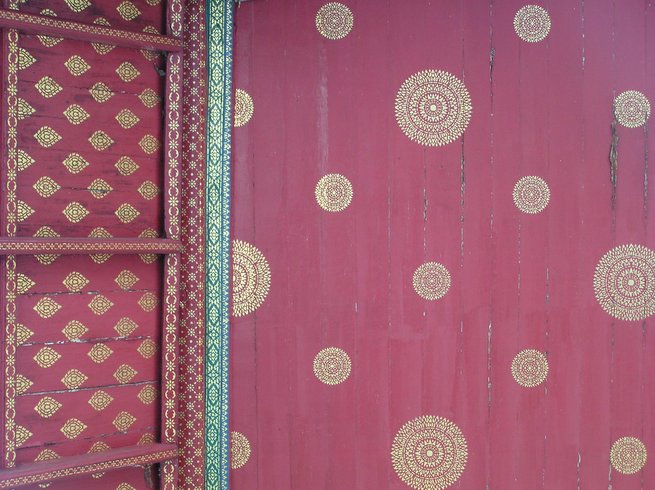
In case you are wondering, this photo is just because.
It's unrelated to my ramblings, which are soon to follow.
Ceiling of a Wat (temple) in Thailand.

Cee has started a collaboration - and she's hit on a favourite of mine: Lists. Oh, how I love lists! So, though I cannot promise that I will consistently post a list on each Monday, I am most enthusiastic about posting lists.

And she's chosen a great one to start: books.

Just before I start, here's another tangent:

The wonderful Judy Horacek has a great cartoon with the caption:
"Behind every great woman...
There's rather a lot of lists."

In no particular order:

Book I:-
Thea Astley's It's Raining in Mango
Gorgeous and evocative writing, so pungent with the sense of North Queensland.

Book II:-
Roberto Calasso's The Marriage of Cadmus & Harmony
I read this instead of studying for my exam on Classical Mythology in first year university. I got exceedingly high marks on that exam ;-) When I grow up, I want to write just like Roberto.

Book III:-
Italo Calvino's If on a Winter's Night a Traveller...
A thoroughly thought-provoking and quite hilarious book of twists and turns, swings and diversions.

Book IV:-
Duong Thu Huong's Paradise of the Blind
I would read everything by this most humane of authors. This work struck me most powerfully.

Book V:-
Haruki Murakami's Norwegian Wood
Isn't it good?

Book VI:-
Milan Kundera's Immortality
and almost everything else by Milan Kundera, but reading this always makes my throat catch.

Book VII:-
Toni Morrison's Song of Solomon
This novel swims as you read it - the lines are blurred through your tears.

Book VIII:-
M John Harrison's The Course of the Heart
Heart stopping magic.

Book IX:-
Margaret Atwood's Negotiating with the Dead
A wonderful read for (want to be) writers everywhere.

Book X:-
Martha Nussbaum's Poetic Justice
Because I hope to be an ethical lawyer and I believe literature will take me there. Martha Nussbaum seems to believe so too and she's a much more complex thinker than I ever will be.

I find it difficult to limit myself to ten books - and I usually recommend to people based on what I know of them; this List is the ten that would undoubtedly appear if you kept at me about what book to read ...

What ten books would you recommend?

Tuesday, December 27, 2005

The Art of Stalking


I spent last weekend with my new (to me) digital camera, Annie Dillard's Pilgram at Tinker Creek and a dilettante attitude under a gorgeous Moreton bay or Port Jackson fig at Orleigh Park, West End. I read and photographed, lazed and wondered. I promise to spend more days like that, rather than like this.

I had been reading Annie Dillard's treatise on how she discovered the art of stalking a musk rat. I followed her advice in a loose way - or at least was inspired by it (at p 184):

In summer, I stalk. Summer leaves obscure, heat dazzles, and creatures hide from the red-eyed sun, and me. I have to seek things out. The creatures I seek have several sense and free will; it becomes apparent that they do not wish to be seen.
Annie Dillard speaks of losing herself in the stalking (at p 198 - 199):
[The muskrat] never knew I was there. I never knew I was there, either. ... My own self-awareness has disappeared. ... I wonder if we do not waste our energy just by spending every waking minute saying hello to ourselves.

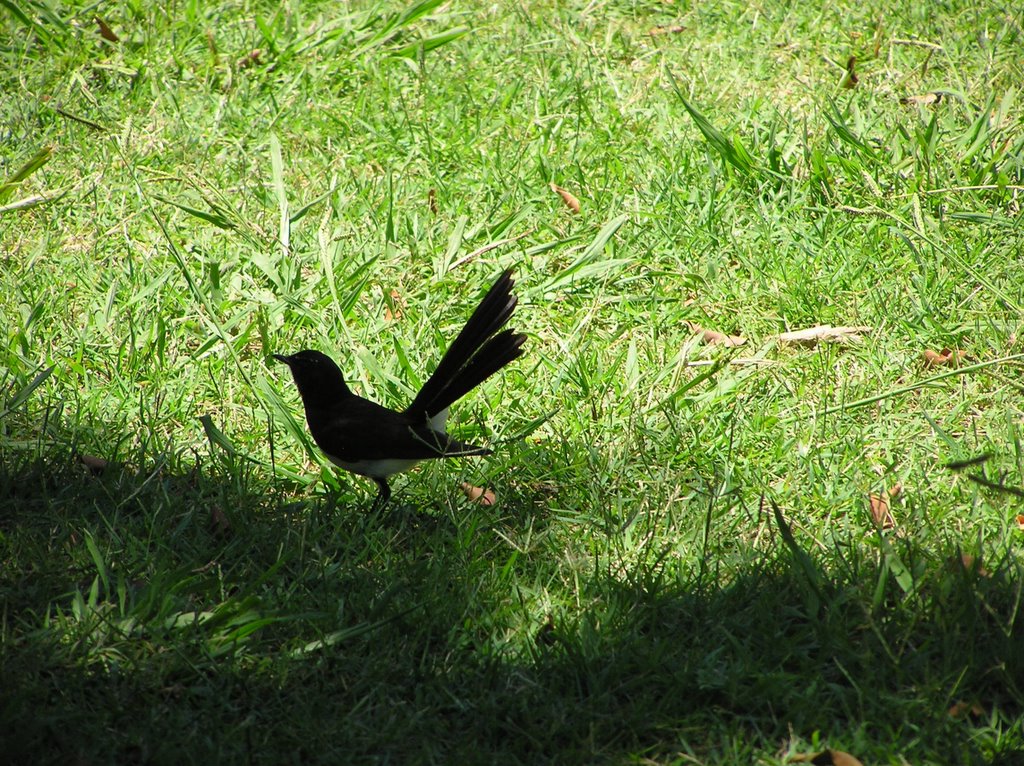
And so I tried to stalk a willy wagtail. There were other people at the park: a couple on another bench under another fig, a sole young man with his swag and a group of people having a picnic. All were absorbed in their own business but I could not evade my awareness of my slow and occassional halting to follow the willy wagtail with a camera. I'd stop where I thought I was just close enough and then cast a look about me to see who had been watching my creep towards the creature. I felt as an exhibit in Monty Python's Silly Walk museum. Invariably the casting about would lead to the willy wagtail flying to another perch and wagging its tail in a taunting, happy way.

This picture was taken while lying on a park bench engrossed in my reading of Annie Dillard's wondrous book. The willy wagtail flew to within inches of my nose and then landed on the grass, wagging a few teasing times. I extracted the camera from its case, pointed and shot.

If you have a interest in the world around you, read Annie Dillard. She sparks and amuses and her writing is nothing short of meditiatively incandescent. I feel as a child - renewed and wondering - when reading her work.

 
Creative Commons License
This work is licensed under a Creative Commons Attribution-NonCommercial-ShareAlike 2.5 License.